Description
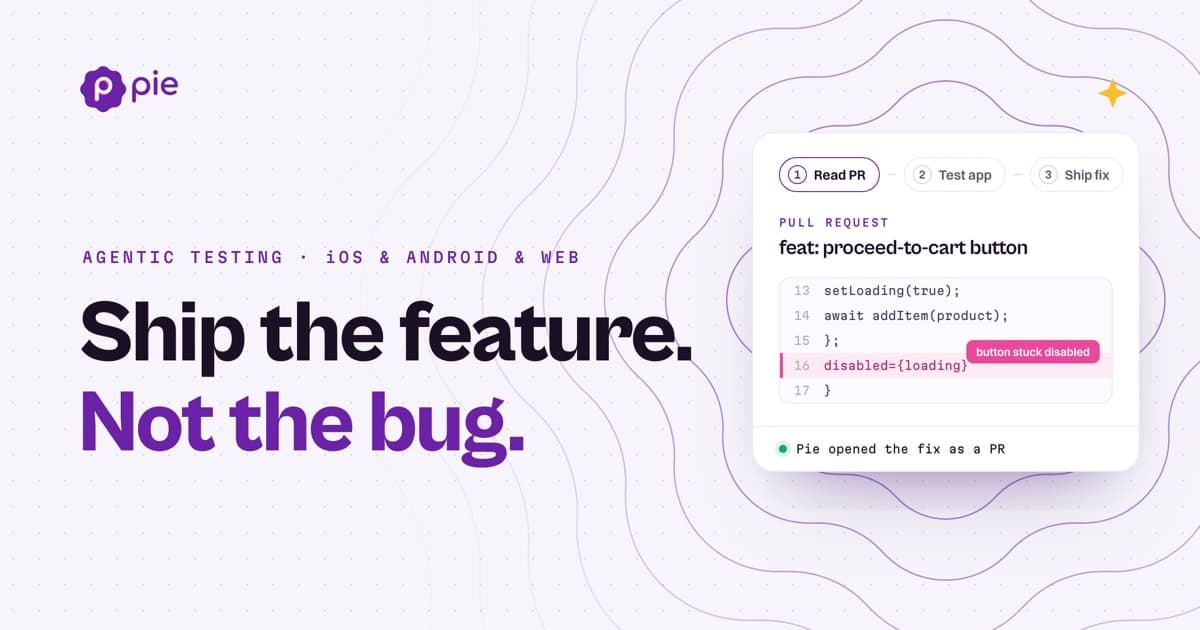
Pie is an agentic testing platform designed to revolutionize quality assurance for web, iOS, and Android applications. It operates by testing every pull request as a real user would, identifying bugs that a human user would encounter, and even generating fix pull requests for review. This approach significantly reduces the burden of manual testing and script maintenance, allowing development teams to ship features faster with increased confidence.
Read More
The platform distinguishes itself from traditional testing tools like Playwright or Selenium by reading the screen visually rather than relying on brittle selectors. This vision-based testing ensures that UI redesigns do not break test coverage and that the system accurately judges the user experience. Pie runs alongside existing test suites, providing a layer of autonomous, user-centric validation. It is designed to prevent false positives by reproducing and reviewing every finding before it reaches the team, presenting only a concise list of real, user-visible bugs.
Setting up Pie is straightforward: users connect their repository and point Pie at their application. The platform then autonomously maps the product and generates test cases without requiring any test scripts or selector tagging. It supports both web and native mobile applications, including complex flows that traditional scripts often struggle to reach. Pie's visual testing approach ensures consistent performance across all user environments.
Security is a core focus, with Pie being SOC 2 Type 2 compliant. Access is strictly scoped to testing requirements, and the platform never merges anything automatically; it opens fix PRs with attached evidence (screenshots, failing flows, reasoning) for team review. A comment-only mode is also available for teams preferring manual intervention.
Pie's methodology, known as the "3P Framework" (Push, Probe, Pass), streamlines the QA process. "Push" involves minimal setup, simply providing a URL or build file. "Probe" deploys a "squad" of AI agents for autonomous discovery, test generation, and parallel execution, mapping the application visually and adopting user personas to create comprehensive test cases. The "Pie Farm" enables massively parallel execution, completing regression suites in minutes. "Pass" focuses on delivering actionable insights by deduplicating issues and providing perfect bug reports, validated by real humans on Pie's QA team to eliminate false positives. This ensures teams receive signal, not noise, enabling them to focus on fixing real problems.
- CategoryAI Code Review & Testing
- Pricing ModelQuote-based
- DeploymentCloud
- PlatformsWeb, iOS, Android
Pie's Core Features
Agentic testing for web, iOS, and Android apps
Tests every pull request like a real user
Opens fix pull requests with evidence (screenshots, failing flow, reasoning)
No test scripts to write or selectors to maintain
Vision-based testing adapts to UI changes automatically
Autonomous discovery and test case generation
Massively parallel test execution (Pie Farm)
Deduplicated issue reporting with root cause analysis
Human-validated bug reports to eliminate false positives
SOC 2 Type 2 compliant for data security
Integrates with GitHub, GitLab, Jira, Slack, and CI/CD pipelines
Supports complex workflows and authentication
Plain-English test case creation (Pie Canvas)
Real-time test execution monitoring
Volume pricing for multiple applications
How to use Pie?
Connect Repository: Link your code repository (e.g., GitHub, GitLab) to Pie.
Point to App: Provide the URL for your web app or upload the build file for mobile apps.
Define Credentials: Add test accounts and feature flag settings for gated or complex flows.
Trigger Tests: Comment @pie-pr-bot test on a pull request or configure automatic triggers in your CI/CD pipeline.
Review Results: Examine the detailed bug reports and fix PRs posted directly to your development tools.
Provide Feedback: Dismiss findings you don't care about to train the AI and refine future test runs.
Pie's Use Cases
- Pull Request Testing
- Regression Testing
- Mobile App QA
- Web App QA
- UI Change Validation
- Bug Reporting Automation
- Continuous Integration QA
- Exploratory Testing Augmentation
- Feature Flag Testing
- Codebase Quality Assurance