
Description
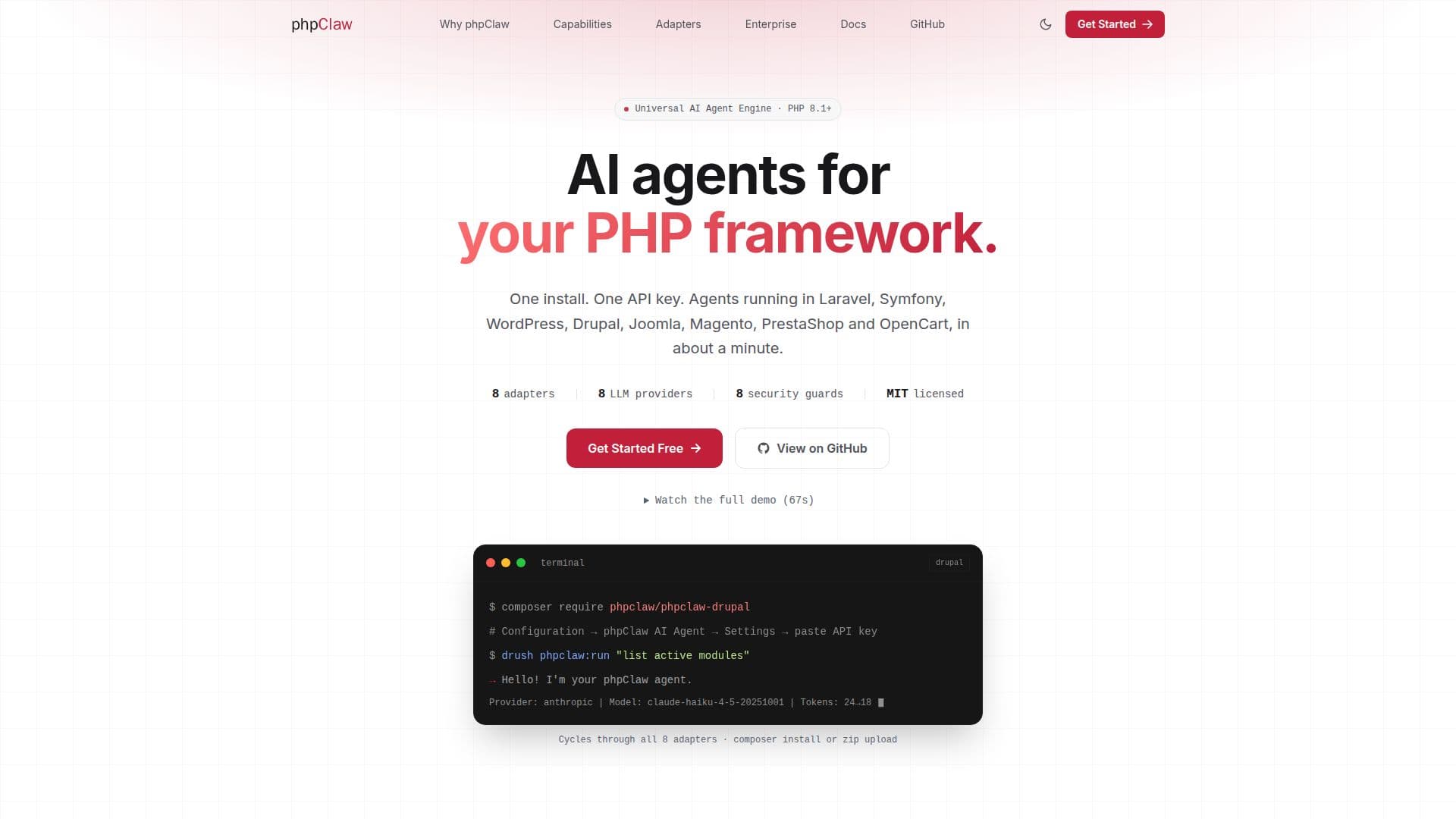
phpClaw is an innovative open-source AI agent engine designed specifically for PHP developers. It allows the integration of production-ready AI agents into existing applications using popular frameworks such as Laravel, Symfony, WordPress, and others. With phpClaw, developers can add AI capabilities to their applications with just one API key, ensuring a seamless integration process.
Read More
The platform supports eight major PHP frameworks and CMSs, including Drupal, Joomla, PrestaShop, OpenCart, and Magento. It offers eight first-party adapters that integrate natively with each framework, providing a familiar environment for developers. phpClaw also supports eight LLM providers, including Anthropic, OpenAI, Groq, Gemini, Mistral, DeepSeek, and local Ollama, allowing developers to switch providers without altering application code.
Security is a top priority for phpClaw, with eight built-in security guards that protect against prompt injection, destructive SQL, and PII detection, among others. The platform is self-hosted, ensuring that data remains secure and private, with no need for fine-tuning or sending data to third parties.
phpClaw is licensed under the MIT license, making it free to use without any usage fees or per-token markup. It is designed to run on your own server, using the framework's native commands and database layers, providing a secure and efficient solution for PHP developers looking to integrate AI into their applications.
- CategoryAI Agent Builders
- Pricing ModelFree
- DeploymentSelf-hosted
- PlatformsPHP frameworks
phpClaw's Core Features
Open-source under MIT license
Supports eight PHP frameworks and CMSs
Integrates with eight LLM providers
Built-in security guards
Self-hosted solution
Native framework integration
Tool-calling capabilities
Persistent memory support
How to use phpClaw?
Install: Add the phpClaw package to your project
Configure: Set your API key for LLM provider
Integrate: Use framework-specific adapter
Deploy: Run agents on your server
phpClaw's Use Cases
- AI Integration
- Security Enhancement
- Framework Compatibility
- Provider Flexibility
- Self-Hosting