
Description
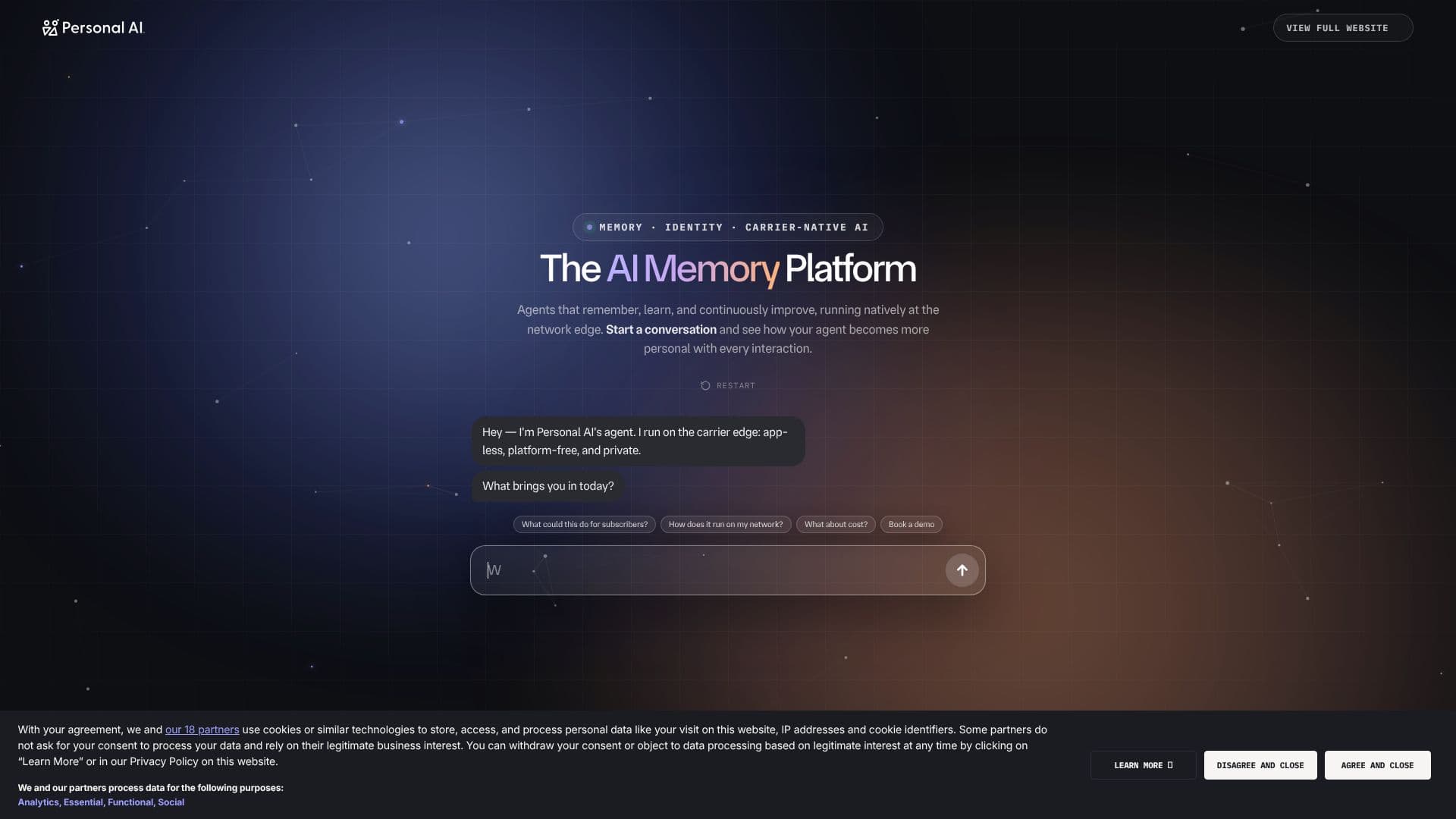
Personal AI has shifted from a consumer memory app into carrier-native memory infrastructure. It turns every identity on a telecom network, a phone, a robot, a car, or another connected device, into an evolving AI agent, and treats what it calls tokens as a new primitive alongside voice, text, and data on the carrier's own network.
Read More
The platform is built around a distinction between memory, context, and identity. Memory is personal: it's what an AI has lived, made of experiences and interactions with temporal and episodic structure that accumulate over time. Context is universal: documents, knowledge bases, and uploads that stay static. Identity emerges from memory over time rather than being directly configured. A Memory Core built on five processing steps, encoding, stabilizing, storing, retrieving, and updating, works across memory types including episodic, semantic, working, relationship, temporal, and procedural memory.
On top of that architecture, Personal AI offers persistent AI identity that becomes more personal with use; recall acceleration that layers onto a company's existing retrieval pipelines so context is fetched only when needed; dynamic encoding that automates the memory life cycle; centralized governance for setting permissions, access, and retention policy; and portability, so memory can move across different systems, agents, and assistants instead of starting over each time.
Personal AI reports carrier-network benchmarks measured against traffic on Comcast's network: a 15 millisecond time-to-first-token versus roughly 1,000 milliseconds for cloud LLM baselines, $0.02 per million tokens versus $0.80 for Gemma-27B, and under 500 milliseconds of end-to-end voice latency versus about 1,500 milliseconds for OpenAI's Realtime pipeline, covering the full capture, speech recognition, language model, and text-to-speech pipeline. The product is sold to telecom carriers rather than individual users, requires no app install on the end device, and buyers engage through a carrier briefing or sales conversation rather than public sign-up.
- CategoryAI Personal Assistants
- Pricing ModelContact sales
- DeploymentCloud
- PlatformsWeb
Personal AI's Core Features
Carrier-network memory infrastructure deployed per identity: phones, robots, cars, connected devices
Persistent, evolving AI identity built from accumulated memory
Memory Core with a five-step architecture: encoding, stabilizing, storing, retrieving, updating
Recall acceleration layered onto existing retrieval pipelines
Dynamic encoding that automates the memory life cycle
Centralized governance for memory permissions, access, and retention policy
Cross-system memory portability across agents and assistants
Low-latency on-network inference reported in carrier benchmarks
How to use Personal AI?
Book a briefing: Contact Personal AI to discuss a carrier deployment.
Scope the identities: Decide which network identities, phones, robots, cars, or other devices, get a Memory Core.
Integrate memory: Connect Personal AI's memory architecture to existing retrieval and agent pipelines using its developer docs.
Set governance rules: Configure permissions, access, and retention policy for stored memory.
Deploy and measure: Roll out on-network inference and track latency and cost against a baseline.
Personal AI's Use Cases
- Carrier AI agents
- In-vehicle voice assistants
- Connected robots and devices
- Cross-agent memory portability