
Description
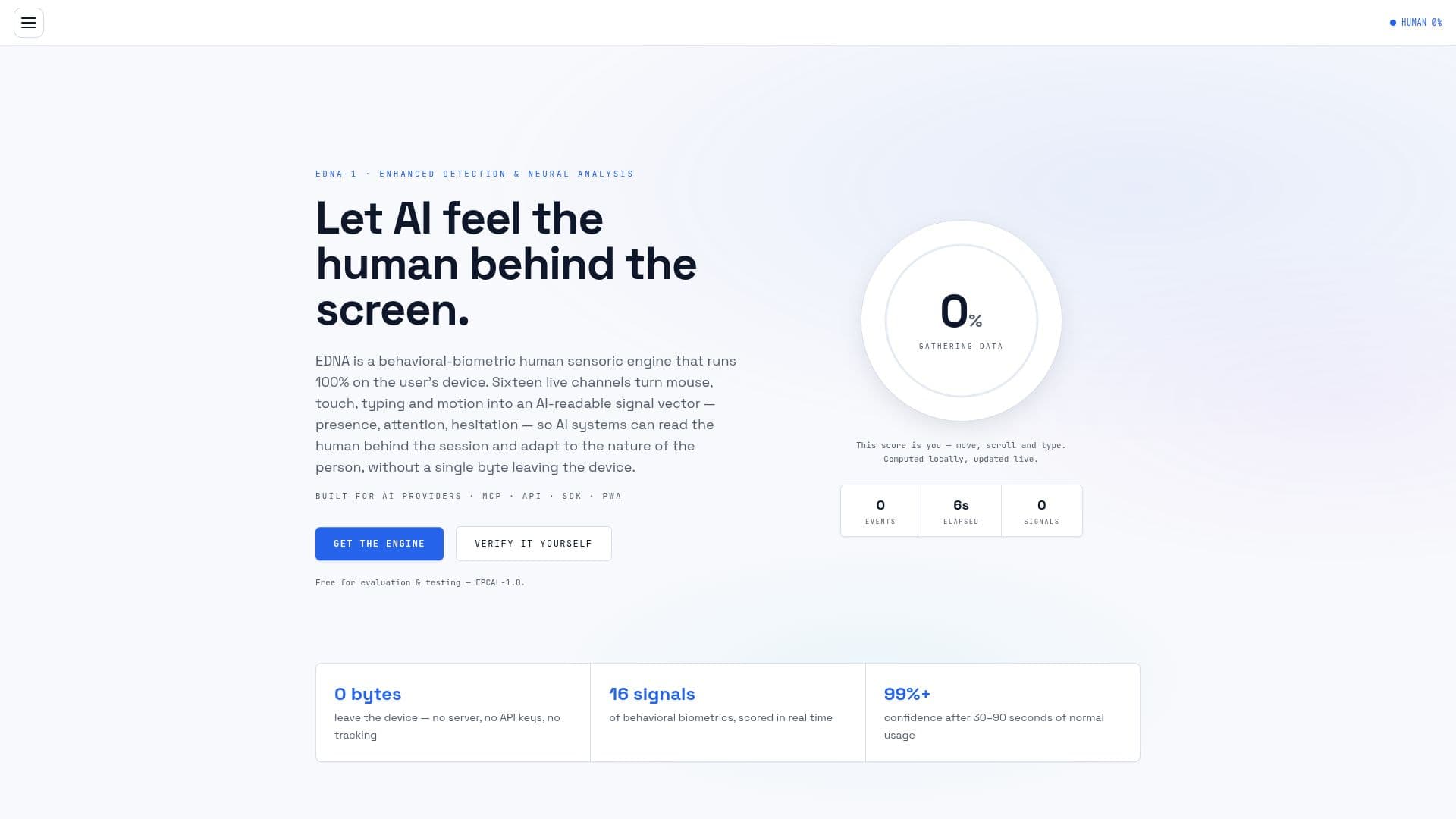
The OpenOS EDNA Engine is a sophisticated behavioral-biometric human sensoric engine designed to provide AI systems with a deeper understanding of human interaction. Running entirely on the user's device, EDNA processes 16 channels of human behavior, including mouse movements, touch, typing, and motion dynamics. These raw inputs are converted into AI-readable quantized signals, allowing AI systems to perceive presence, attention, hesitation, and other nuanced human states without any raw biometric data ever leaving the device.
Read More
At its core, EDNA offers a live EDNA ID Chain, which automatically generates a device-bound identity upon achieving 99.9% human verification. This chain ensures continuity across sessions, enabling AI to recognize the same human over time based on their unique behavioral patterns, rather than relying on traditional identity documents or logins. The system is built with a strong emphasis on privacy, performing all capture, scoring, and classification locally within the user's browser sandbox. Only non-personalized cryptographic hash patterns of behavioral profiles are shared when proof is required, ensuring user data remains secure and private.
EDNA is designed for AI providers, product and platform teams, Web3 and identity builders, and security and trust teams. It allows AI assistants to adapt their responses in real-time based on the user's current state, moving from a "responding AI" to a "perceiving AI." For product teams, it offers ambient behavioral sensing that builds silently in the background, enhancing user experience without interruptions. Web3 projects can leverage EDNA for one-human-one-voice continuity without doxxing, while security teams benefit from real-time bot classification across 16 independent channels without new data liability.
The engine integrates via MCP server, SDK, API, and PWA, supporting various deployment scenarios. It features a transparent pricing model based on credits, with a free tier available for evaluation and testing. The system's claims are independently verifiable, allowing customers and auditors to test the engine against published test vectors. This commitment to transparency and on-device processing makes OpenOS EDNA Engine a robust solution for enhancing AI's understanding of human interaction while upholding stringent privacy standards.
- CategoryComputer Vision Tools
- Pricing ModelCredit-based
- DeploymentOn-device
- PlatformsWeb
OpenOS EDNA Engine's Core Features
16-channel behavioral sensing
Live EDNA ID Chain with automatic genesis at 99.9% human verification
100% on-device capture, scoring, and classification
Raw biometric data never leaves the device
Adaptive response guidance for AI systems
MCP server, SDK, API, and PWA integration
Supabase backend and Stripe billing support
Behavior recognition for distinguishing human from machine
Identity continuity across sessions using cryptographic hash patterns
Privacy architecture with zero raw biometrics transmitted
Human Proof Seal for visible consent and control
Open verification with independently testable engine and published test vectors
Credit-based pricing model with free evaluation credits
Anti-mimic damping ceiling for bot detection
Response controller for AI assistant mode translation (FLOW, FOCUS, EXPLORE, EXECUTE, REFLECT)
Device-bound, append-only behavioral hash chain
How to use OpenOS EDNA Engine?
Integrate the Engine: Download edna.js from the site or GitHub and integrate it into your application via MCP server, SDK, API, or PWA.
Enable Human Sensing: The engine observes user interaction (mouse, touch, typing, motion) on-device to generate live behavioral signals.
Stream Quantized Context: With user consent, stream quantized, non-identifying human context to your AI via the production MCP endpoint using a shared session ID.
Connect Your AI: Configure your AI client (e.g., Kimi, Claude, GPT) to call EDNA's endpoints (edna.get_human_context, edna.get_response_guidance) to read live sensoric data.
Adapt AI Responses: Allow your AI to adapt its tone, pacing, and assistance in real-time based on the perceived human context and interaction dynamics.
Monitor and Verify: Utilize the live engine console and self-test console to monitor engine performance, verify human verification, and test injection resistance.
OpenOS EDNA Engine's Use Cases
- AI Assistant Adaptation
- Continuous Bot Detection
- User Identity Continuity
- Enhanced User Experience
- Web3 Identity Verification
- Anti-Fraud and Anti-Abuse
- Behavioral Biometric Sensing
- AI Model Contextualization