Description
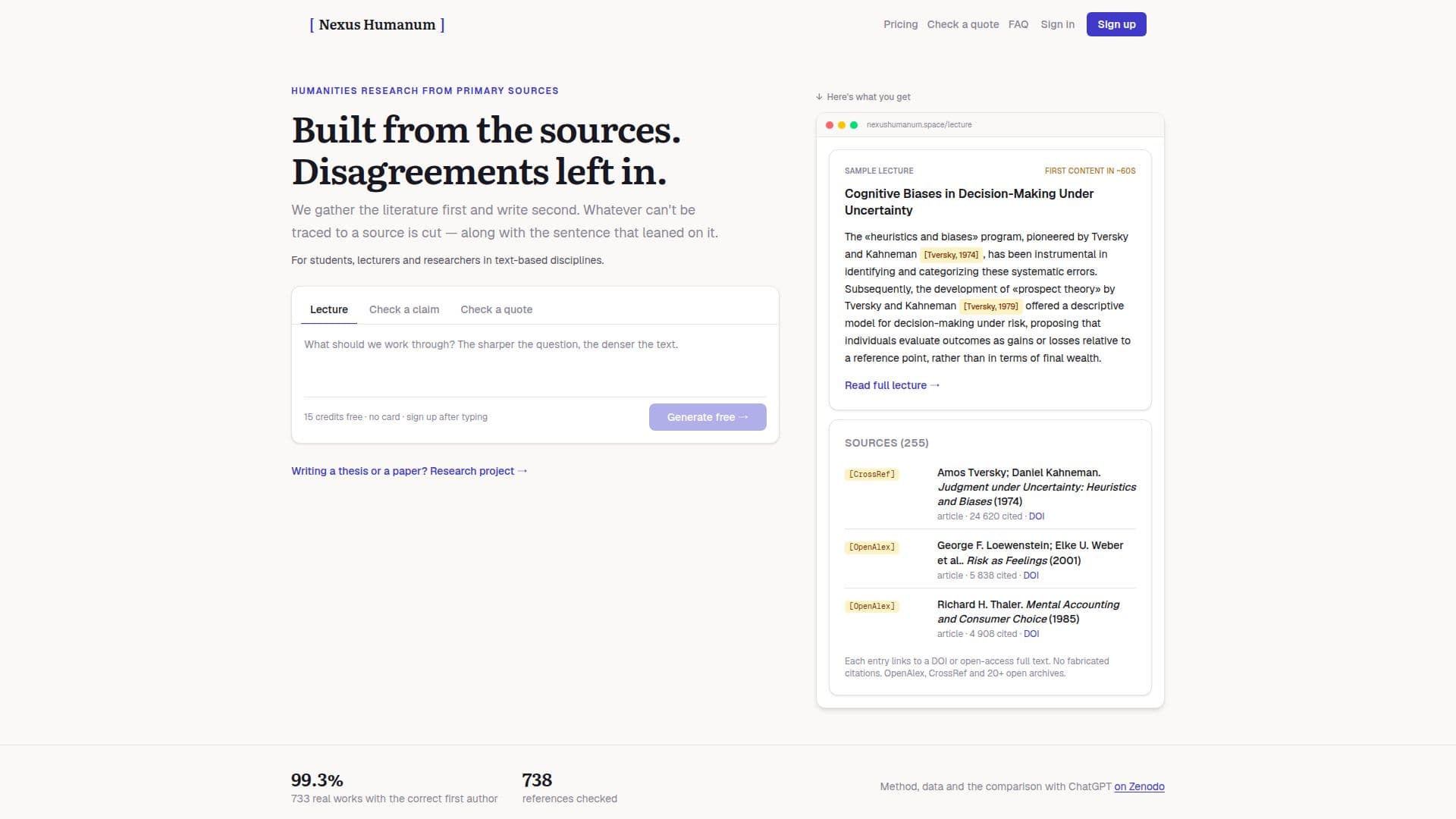
Nexus Humanum specializes in humanities research, offering a unique approach to studying topics directly from primary sources. Unlike traditional summaries or rephrased content, the platform delves into subjects by presenting various positions, including those that contradict each other, ensuring a comprehensive and nuanced understanding. Each piece of content is built from extensive literature, with every claim meticulously traced back to its original source through DOIs or open-access full texts from over 25 open archives, including OpenAlex, CrossRef, the Marxists Internet Archive, and Project Gutenberg.
Read More
The service is designed for students, lecturers, and researchers in text-based disciplines such as philosophy, psychology, history, sociology, literary theory, and anthropology. Users can input their thesis, paper, or research topic, add their literature via DOIs, reference lists, or PDFs, and then interact with the content. Key capabilities include receiving answers directly from full texts with verbatim quotes, checking claims against supporting or disputing sources, and verifying citations in drafts. The platform also identifies missing key works and thinkers on a given topic, helping users build robust bibliographies in various formats like GOST, APA, BibTeX, RIS, and Word.
A core differentiator of Nexus Humanum is its rigorous verification process. The platform prioritizes grounding content in actual sources, meaning any claim not traceable to a genuine source is removed, even if it means losing otherwise good material. This contrasts with chatbots that may generate text first and then attempt to find supporting evidence. Nexus Humanum inverts this process: it first assembles a corpus from open archives, then reads the material, and only then generates text constrained by what was found. This ensures the bibliography is not merely decorative but fully verifiable.
Users can choose between two main formats: 'Lecture' and 'Course'. A 'Lecture' provides a long text with arguments and counter-arguments, typically taking 5–15 minutes to generate depending on the chosen plan (Light or Pro). A 'Course' consists of four to six lectures centered around a single question, culminating in an essay. The 'Seminar' tab offers an interactive experience where the platform poses questions based on points of sharp disagreement in the sources, remembering questions users might have dodged. All generated content remains private to the user and can be exported as PDF, copied, or used for personal writing, with full ownership retained by the user.
Nexus Humanum offers a free tier with 15 credits upon sign-up, sufficient for five full Light lectures, without requiring credit card details. Paid plans include Student (30 credits for $5/month), Pro (96 credits for $15/month), and Power (272 credits for $40/month), with unused credits rolling over. The platform supports both English and Russian for its interface and lectures, and sources are pulled in their original languages, then discussed in the user's chosen language.
- CategoryAI Research Assistants
- Pricing ModelFreemium
- DeploymentCloud
- PlatformsWeb
Nexus Humanum's Core Features
Humanities research from primary sources
Disagreement analysis with verbatim quotes
Citation verification against OpenAlex, CrossRef, and 20+ open archives
Research project support for theses and papers
Answers from full texts with specific locations
Claim checking against supporting, disputing, or qualifying sources
Draft checking for citation accuracy
Identification of missing literature and key works
Bibliography generation in GOST, APA, BibTeX, RIS, and Word formats
Lecture format for in-depth topic exploration
Course format for structured learning with essays
Interactive 'Seminar' tab for critical questioning
PDF export and text copying for generated content
Private user library for all generated lectures
Multilingual support for English and Russian
How to use Nexus Humanum?
Sign Up: Create an account to receive 15 free credits without needing a card.
Enter Topic: Input your research topic, thesis, or paper details.
Add Literature: Upload DOIs, reference lists, or PDFs of your existing literature.
Generate Content: Choose between a 'Lecture' or 'Course' to generate in-depth analysis.
Review & Interact: Read the generated text, check claims, verify citations, and explore disagreements.
Refine Research: Use the 'Seminar' tab for interactive questioning or identify missing literature.
Export & Cite: Export your lecture as a PDF or copy text, citing the original sources in your work.
Nexus Humanum's Use Cases
- Academic Research
- Essay Writing
- Literature Review
- Citation Verification
- Draft Checking
- Seminar Preparation
- Understanding Complex Topics
- Bibliography Creation
- Exploring Disagreements