
Description
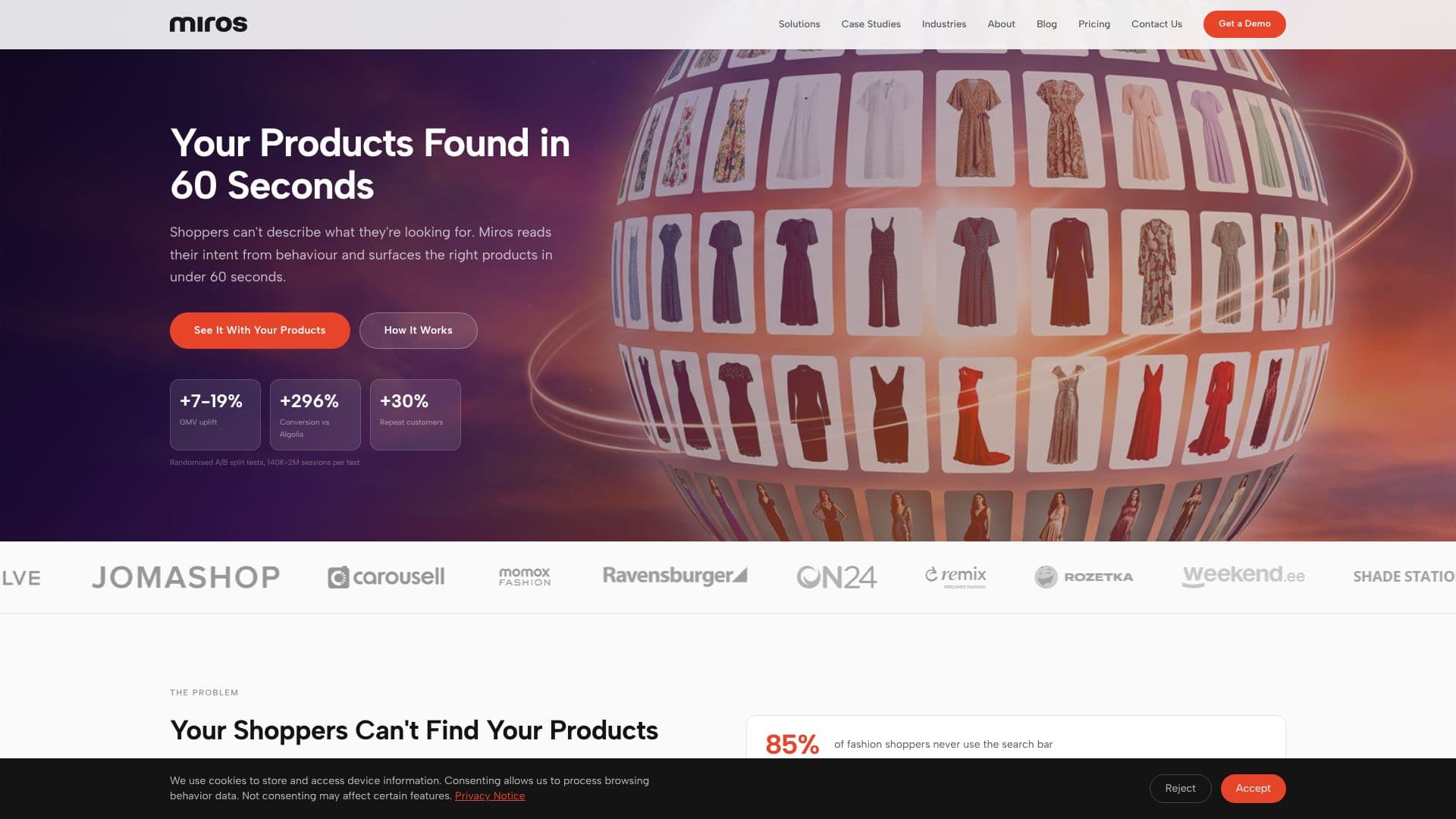
Miros addresses a critical problem in e-commerce: shoppers often struggle to articulate their needs, particularly in visually driven categories like fashion, furniture, and decor. Traditional search bars, filters, and chatbots require explicit input, leading to lost revenue when shoppers cannot find what they want. This is especially true for Gen Z, who increasingly prefer visual discovery platforms over traditional search engines.
Read More
Miros offers an intelligent feed that acts as an intent layer for your discovery stack. Unlike other solutions that rely on keywords or explicit descriptions, Miros' AI analyzes behavioral signals such as scroll velocity, clicks, dwell time, and ignored items to build a real-time preference profile for each visitor. This allows the platform to understand shopper intent even when they can't express it verbally.
The solution works by first understanding products through AI that extracts thousands of visual and semantic attributes per image without manual tagging. It then decodes shopper intent by interpreting behavioral signals in real-time. Conflicts in signals are resolved to synthesize coherent preference profiles. Finally, this single intent profile powers all discovery surfaces on a site simultaneously, including search, browse, recommendations, and shop-the-look features.
Empirical data from A/B tests across six retailers demonstrates significant impact, including up to a 296% increase in conversion rate compared to Algolia, and a 7-19% GMV uplift. Other reported benefits include higher Average Order Value (AOV), increased repeat purchases, and reduced Customer Acquisition Cost (CAC).
Miros is designed to integrate easily into existing e-commerce platforms, working alongside solutions like Algolia or Elasticsearch. The platform can be deployed in as little as two weeks, with a working demo provided on a client's catalog before commitment. It offers flexibility through JS widgets or a GraphQL API, supporting both headless and traditional setups. The AI reads product images directly, eliminating the need for manual tagging, and its modular design allows businesses to start with one feature and expand later.
- CategoryAI Shopping Assistants
- Pricing ModelContact sales
- DeploymentLive in 2 Weeks
- PlatformsWeb
Miros AI's Core Features
AI-powered shopper intent analysis from behavioral signals
Real-time visitor preference profiling
Automated visual and semantic attribute extraction from product images
Unified intent profile for search, browse, recommendations, and shop-the-look
Integration with existing discovery stacks (Algolia, Elasticsearch, etc.)
Deployment in under 2 weeks with a working demo
No manual product tagging required
JS widgets and GraphQL API for flexible integration
Supports headless and traditional e-commerce setups
Modular design for phased implementation
High-speed response times (50-300ms)
Supports over 1 billion items
Processes over 500 million signals per month
Holds 5 patents
How to use Miros AI?
Configure: Define integration points and data flow with your existing e-commerce platform.
Integrate: Deploy JS widgets or connect via GraphQL API.
Train AI: Allow Miros AI to process your product catalog and initial behavioral data.
Activate: Launch Miros-powered discovery surfaces across your site.
Monitor: Track performance metrics and A/B test results.
Optimise: Refine AI models and discovery strategies based on ongoing analysis.
Miros AI's Use Cases
- Visual Search Enhancement
- Personalized Recommendations
- Optimized Browse Experience
- Shop-the-Look Features
- Reduced Cart Abandonment
- Increased Conversion Rates
- Enhanced Mobile Shopping