
Description
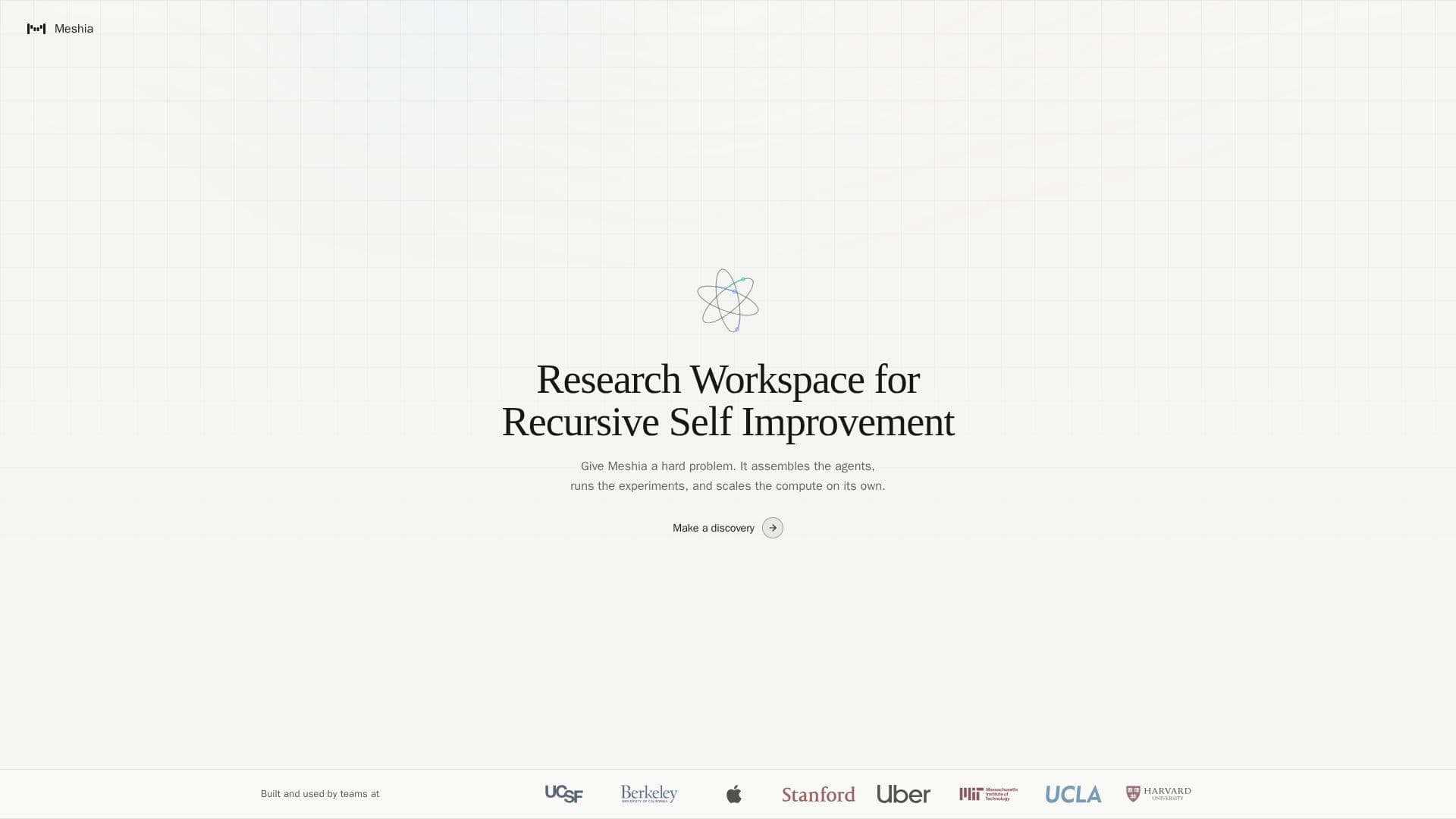
Meshia offers a comprehensive live AI research workspace, centralizing the management of GPUs, agents, experiments, files, and replayable proof. It provides a unified control plane that allows users to command various resources from a single interface, streamlining the research process for machine learning experiments and continuous evaluation loops.
Read More
The platform is engineered to address challenging problems by autonomously assembling agents, running experiments, and scaling compute resources. It supports recursive self-improvement, enabling AI systems to evolve and optimize their performance over time. Meshia integrates diverse compute resources, including GPUs (H100 SXM, A100 SXM, L40S) and TPUs (TPU v6e), along with CPU options (AMD EPYC, Intel Xeon), to provide a flexible and powerful environment for AI development.
Key capabilities include built-in deployments, allowing users to transform checkpoints into live APIs without leaving the research environment. It facilitates traffic distribution across multiple cloud providers, ensuring high capacity and resilience. Users can monitor requests, latency, and errors in real-time, gaining immediate insights into deployment performance.
Meshia's orchestration system scales problems from a single agent to thousands, all sharing memory and maintaining focus on a common objective. The orchestrator indexes shared context, audits decisions, and enforces time and resource budgets, ensuring that large agent swarms operate cohesively as an accountable research team. The platform binds scattered compute into a single workspace that can dynamically expand around ongoing runs, eliminating the need for teams to rebuild environments.
The provisioner optimizes resource placement based on availability, region, and latency, maintaining high-bandwidth communication between clusters across different providers. This transforms fragmented compute resources into a unified workspace. Meshia also includes a file system for research, keeping weights, artifacts, and context together to ensure seamless progress across workspaces and teammates. It offers unmatched compute availability and resilience by meshing resources from providers globally.
Meshia provides a free tier that includes 3 workspaces (including those in owned teams), up to 2 Starter GPUs shared across workspaces, and 100 GB of storage. Additional storage is billed at $0.08/GB/month. Users can connect their own machines via SSH or Meshia Node without counting towards limits. The Pro tier offers unlimited workspaces, access to a wider range of GPUs and TPUs (H100, H200, B200, TPU v5p), 2 TB of storage, and Pro limits for all team members. Enterprise plans include reserved capacity, custom storage, dedicated support, SLA, and data residency controls. The free tier also supports connecting personal compute and agent subscriptions like ChatGPT, Claude, and Antigravity.
- CategoryMachine Learning & Data Science
- Pricing ModelFreemium
- DeploymentCloud
- PlatformsWeb
Meshia's Core Features
Live AI research workspace
GPU and TPU management
Agent orchestration for thousands of agents
Experiment tracking and management
File system for research artifacts
Built-in deployments for live APIs
Traffic distribution across cloud providers
Real-time monitoring of requests, latency, and errors
Recursive self-improvement capabilities
Provider-agnostic compute integration
Autoscaling of compute resources
Inspectable artifacts for reproducibility
Cost-efficient compute options
Custom built global file system for data storage
How to use Meshia?
Define Problem: Give Meshia a complex problem to solve.
Orchestrate Agents: Meshia assembles agents and scales compute automatically.
Run Experiments: Execute machine learning experiments and long-running evaluation loops.
Monitor Performance: Watch requests, latency, and errors in real-time.
Deploy Models: Turn a checkpoint into a live API without leaving the research workspace.
Scale Resources: Expand compute resources around the run as needed, across providers.
Manage Artifacts: Keep weights, artifacts, and context together in the integrated file system.
Meshia's Use Cases
- AI Model Training
- Agentic AI Development
- ML Experimentation
- Live API Deployment
- Recursive Self-Improvement
- Distributed Compute Management
- Collaborative AI Research
- Long-Running Evaluations
- Resource-Intensive Workloads