Description
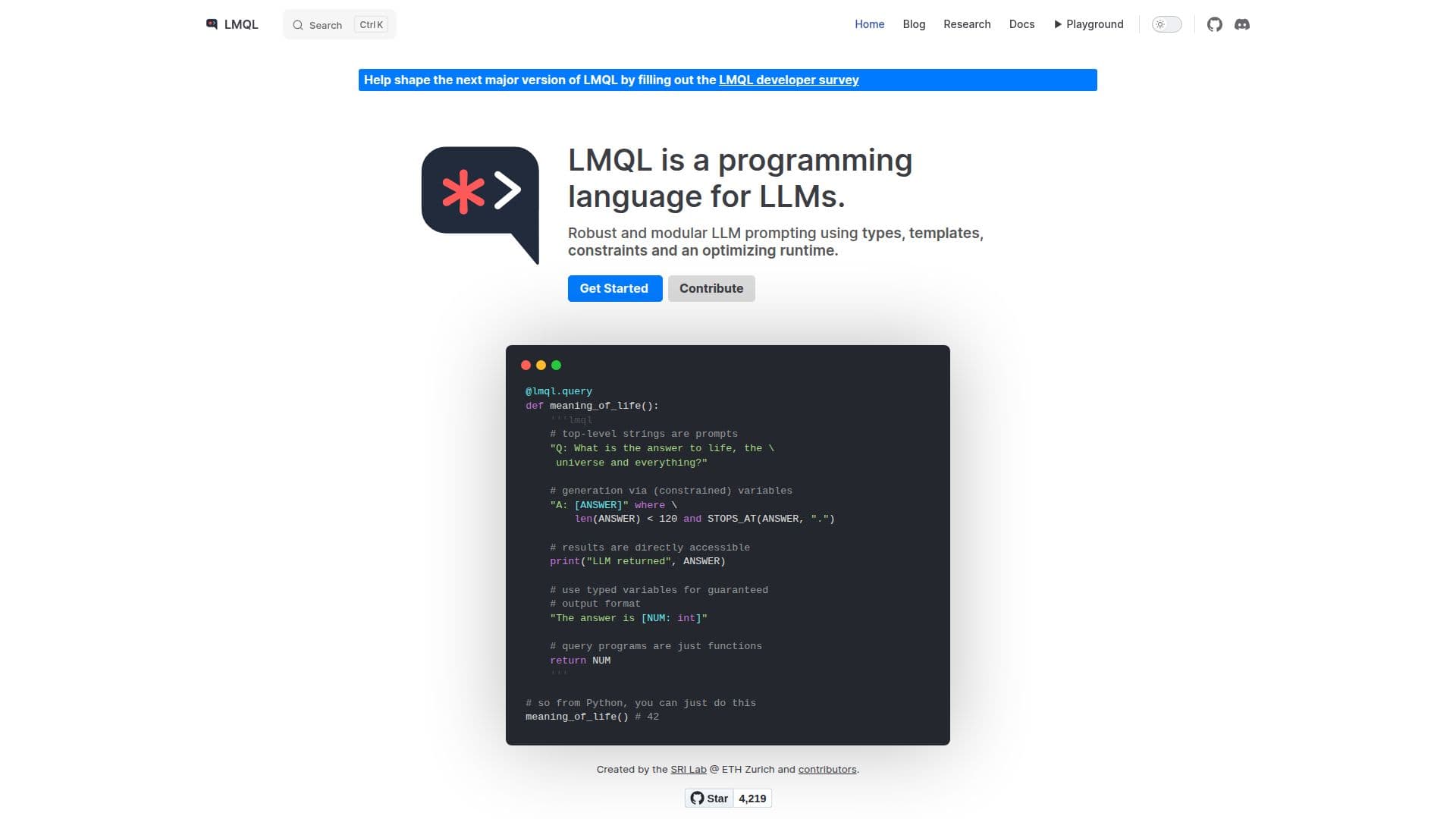
LMQL, or Language Model Query Language, is a specialized programming language developed for interacting with large language models (LLMs). Created by the SRI Lab at ETH Zurich and contributors, LMQL provides a robust and modular framework for LLM prompting. It utilizes types, templates, constraints, and an optimizing runtime to streamline the process of constructing and executing queries.
Read More
One of the key features of LMQL is its support for nested queries, which introduces procedural programming to the realm of prompting. This allows for modularized local instructions and the re-use of prompt components, enhancing the flexibility and reusability of code. LMQL's design ensures that LLM code is portable across several backends, including llama.cpp, OpenAI, and Transformers, enabling users to switch between them with a single line of code.
LMQL's prompt construction and generation are implemented through expressive Python control flow and string interpolation. This approach allows for the creation of complex prompts that can include control flow and branching behavior, providing a high degree of customization in how prompts are constructed and executed.
The language also supports constraint clauses, which enable users to specify logical, high-level constraints on the output. These constraints are automatically translated into character-level constraints that can be enforced during text generation, ensuring that the output adheres to specified requirements.
LMQL is designed for developers and researchers who need to interact with LLMs in a structured and efficient manner. It provides a powerful toolset for creating and managing LLM queries, making it an invaluable resource for those working in fields that require advanced language model interactions.
- CategoryMachine Learning Platforms
- Pricing ModelFreemium
- DeploymentLocal, Web-based
- Platformsllama.cpp, OpenAI, Transformers
LMQL Programming Language's Core Features
Robust LLM prompting
Modular query design
Nested queries support
Portable across backends
Expressive Python control flow
String interpolation for prompts
High-level constraint clauses
Optimizing runtime
How to use LMQL Programming Language?
Install: Set up LMQL locally or use the web-based Playground IDE
Write Query: Create a simple prompt statement with constraints
Extend: Add complex logic and different decoding algorithms
Explore: Use examples in the Playground IDE for inspiration
LMQL Programming Language's Use Cases
- LLM Interaction
- Prompt Optimization
- Backend Portability
- Constraint Enforcement
- Procedural Prompting