Description
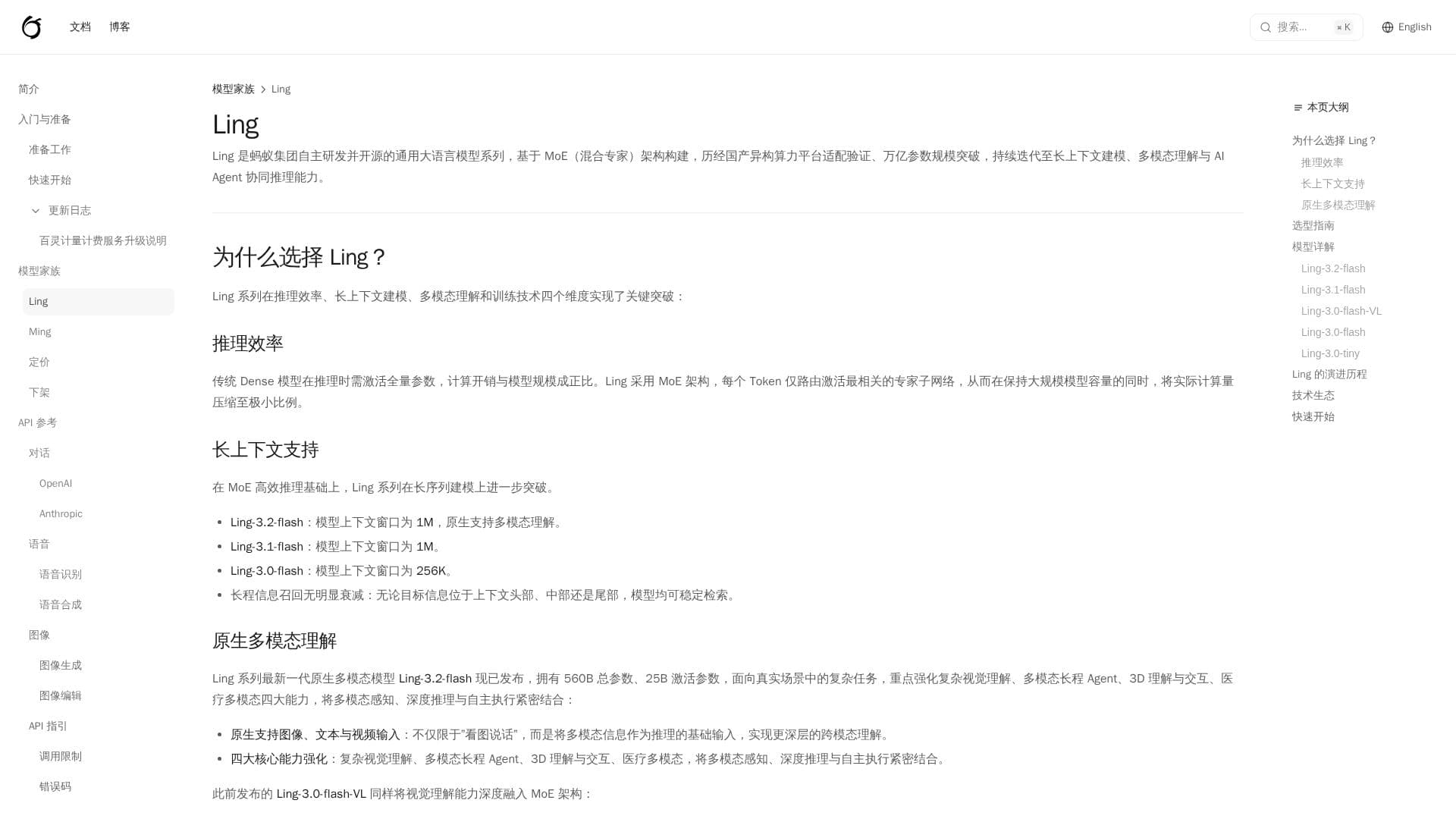
Ling is a series of general-purpose large language models developed and open-sourced by Ant Group. These models are built upon a Mixture-of-Experts (MoE) architecture, which allows them to achieve high capacity while maintaining low computational costs during inference. This design ensures that only the most relevant expert sub-networks are activated for each token, significantly reducing the actual computation required compared to traditional dense models.
Read More
The Ling series has undergone extensive development, including adaptation and verification on domestic heterogeneous computing platforms and breakthroughs in trillion-parameter scale. The models continuously iterate to enhance capabilities such as long-context modeling, multimodal understanding, and AI Agent collaborative reasoning. Key advancements include support for context windows up to 1M tokens, ensuring stable information retrieval across long sequences without significant decay.
Ling offers native multimodal understanding, with its latest generation, Ling-3.2-flash, supporting image, text, and video inputs. This model, with 560B total parameters and 25B activated parameters, is designed for complex real-world tasks, strengthening capabilities in complex visual understanding, multimodal long-range agents, 3D understanding and interaction, and medical multimodal applications. It integrates multimodal perception, deep reasoning, and autonomous execution.
The model family includes several versions tailored for different needs. Ling-3.2-flash is the latest native multimodal model, ideal for complex visual and agentic tasks. Ling-3.1-flash is optimized for long-process tasks and agent scenarios, suitable for daily office work, long-term software development, and complex agent tasks. Ling-3.0-flash-VL is a native multimodal model with a visual feedback loop mechanism, enhancing reliability in tasks like medical report interpretation and GUI automation. Ling-3.0-flash is a cost-effective, high-speed model for high-frequency tasks, offering fast response times and stable tool calling. Ling-3.0-tiny is a lightweight model designed for edge deployment and offline operation, suitable for real-time interaction and resource-constrained environments.
Ling models are available via API, supporting both OpenAI and Anthropic protocols, making integration into various AI programming tools and agent frameworks straightforward. Pricing is consumption-based, calculated per token, with promotional discounts and a daily free tier of 500,000 tokens (or a monthly 10 RMB token deduction coupon after a billing system upgrade). Enterprise users can contact customer service for higher QPS limits and dedicated resources. The project also fosters an open-source community, sharing research results through Inclusion AI.
- CategoryAI Models & LLMs
- Pricing ModelPay-as-you-go
- DeploymentCloud, Edge, Local Offline
- PlatformsWeb
Ling's Core Features
MoE (Mixture-of-Experts) Architecture for efficient inference
Long-context modeling with up to 1M token window support
Native multimodal understanding for image, text, and video inputs
Complex visual understanding capabilities
Multimodal long-range Agent capabilities
3D understanding and interaction
Medical multimodal analysis and report interpretation
Visual feedback closed-loop mechanism for self-correction
High throughput and low latency inference (up to 1000 tokens/s)
Support for edge deployment and local offline operation
Tool-use and UI automation capabilities
Open-source research results via Inclusion AI community
API access compatible with OpenAI and Anthropic protocols
Consumption-based pricing with free daily/monthly token allowances
Optimized for various tasks including office automation, software development, and professional consulting
How to use Ling?
Get API Key: Obtain access credentials from the API console after binding an Alipay account.
Make First Call: Complete your first API request using OpenAI compatible SDK or HTTP requests.
Select Model: Choose from Ling-3.2-flash, Ling-3.1-flash, Ling-3.0-flash-VL, Ling-3.0-flash, or Ling-3.0-tiny based on task requirements.
Integrate: Connect Ling models to AI programming tools like Claude Code, OpenClaw, Kilo Code, or Hermes Agent.
Develop Applications: Utilize Ling's capabilities for tasks such as complex visual understanding, long-range agent execution, or office automation.
Monitor Usage: Track token consumption and manage billing through the Ling control panel.
Ling's Use Cases
- Complex Visual Understanding
- Multimodal Long-Range Agents
- 3D Understanding & Interaction
- Medical Multimodal Analysis
- Daily Office Automation
- Software Development Tasks
- Professional Consulting & Analysis
- Visual Feedback Programming
- GUI Automation
- Real-time Video Learning
- High-Concurrency Data Processing
- Edge Device Deployment