Description
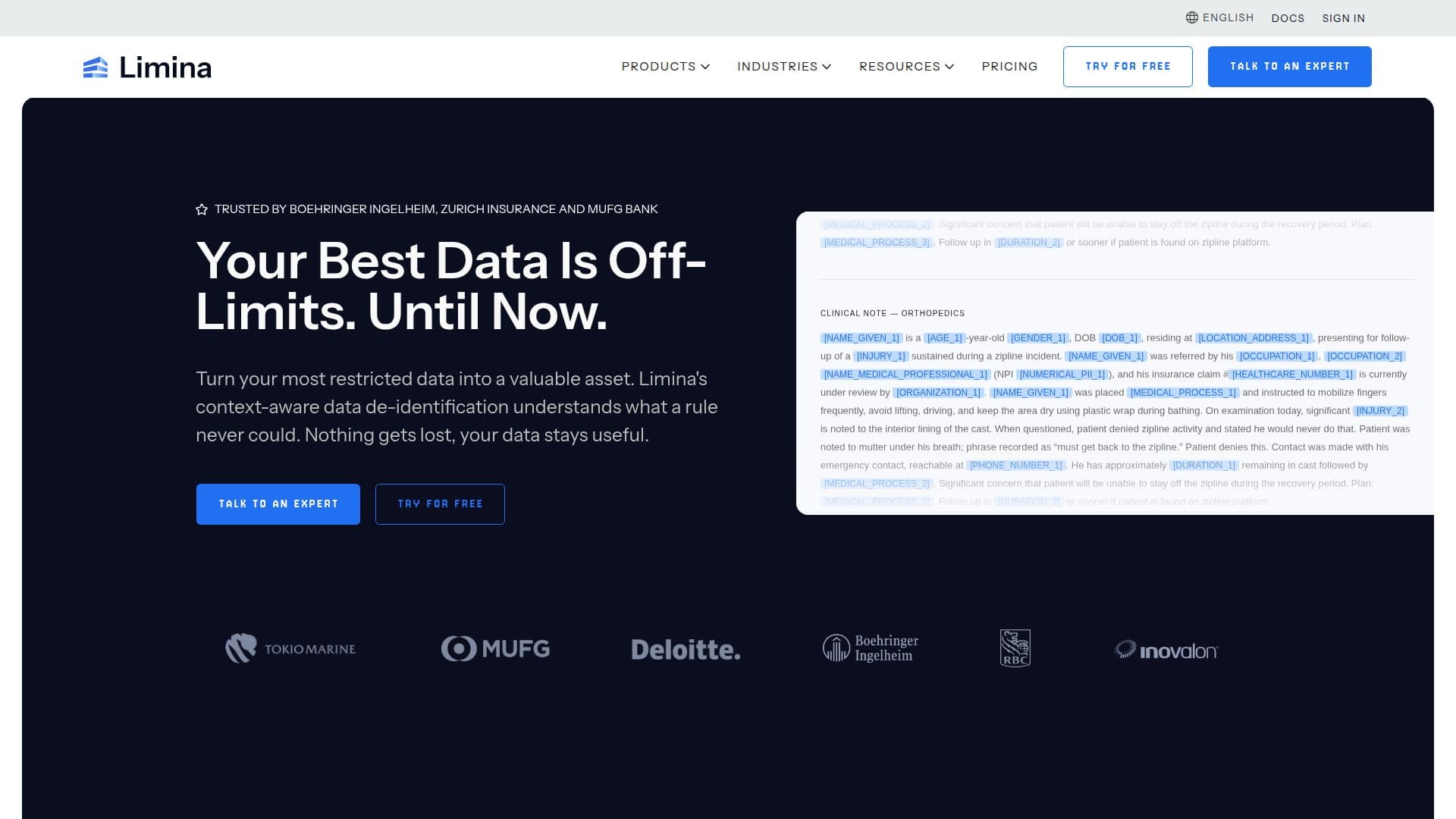
Limina is a data de-identification platform, previously known as Private AI, now operating under its own name and branding. It detects and removes personally identifiable, health, and payment information (PII, PHI, and PCI) from unstructured data so organizations can use that data for AI training, analytics, or sharing without exposing sensitive details.
Read More
The core pitch is context over pattern matching. Rule-based tools and general-purpose cloud APIs miss entities that do not look like an obvious pattern, such as a name that reads like a common word, or a credit card number spoken across several turns of a conversation. Limina says it instead reads context to catch these cases, covering more than 50 entity types (names, Social Security numbers, credit cards, medical conditions, medications, passport numbers, and international variants) across 52 languages, including code-switching where a speaker or document mixes languages. It handles messy real-world input, including transcription errors, OCR mistakes, and handwritten forms, in text, images, audio, and structured data formats.
Limina's workflow runs in three stages. Identify detects sensitive entities in real time and links related information across a document or conversation. Transform then redacts, pseudonymizes, generates synthetic replacement data, or generalizes entities, depending on what the downstream use case needs. Comply produces expert-determination-ready outputs and audit documentation to support HIPAA, GDPR, PCI-DSS, CPRA, Japan's APPI, and Quebec's Law 25. The platform deploys as a container inside a customer's own VPC or on-premises infrastructure, so data does not leave that environment during processing, and it integrates with AWS, Azure, Snowflake, and NVIDIA NeMo.
Limina reports 99.5% accuracy on physician conversations in a deployment with Providence Health, and says a major pharmaceutical customer cut a multi-day document redaction process down to minutes. In its own benchmark test of roughly 45,000 words against major cloud providers' general-purpose PII tools, Limina reports missing between 0.2% and 7% of entities, against 13.8% to 46.5% missed by the general-purpose tools it compared against.
Customers named on Limina's site include Boehringer Ingelheim, Zurich Insurance, MUFG Bank, Providence, Semalytix, Be My Eyes, and Rilla, spanning pharma, insurance, banking, healthcare, and contact-center use cases. Limina's accuracy claims have been independently validated by Armilla AI, backed by SwissRe.
- CategoryAI Privacy Tools
- Pricing ModelFreemium
- DeploymentOn-premise, Cloud
- PlatformsWeb
Limina's Core Features
Context-aware detection of PII, PHI, and PCI across text, images, audio, and documents
50+ entity types, including names, SSNs, credit cards, medical conditions, medications, and passport numbers
52 supported languages, including regional variants and code-switching
Redaction, pseudonymization, synthetic data generation, or generalization of detected entities
Deployment as a container inside a customer's own VPC or on-premises, so data never leaves that environment
Expert-determination-ready compliance reports for HIPAA, GDPR, PCI-DSS, CPRA, APPI, and Law 25
Handles messy real-world input: ASR errors, OCR mistakes, and handwritten forms
Integrations with AWS, Azure, Snowflake, and NVIDIA NeMo
How to use Limina?
Talk to Limina: contact the team to scope your data types, volume, and compliance requirements.
Deploy the container: install Limina inside your own VPC or on-premises environment.
Identify entities: run Limina's real-time detection across your text, audio, image, or document data.
Transform the output: choose redaction, pseudonymization, synthetic data, or generalization for each use case.
Generate compliance reports: produce expert-determination-ready documentation for your regulator or auditor.
Limina's Use Cases
- Healthcare data de-identification
- Regulatory compliance reporting
- AI training data preparation
- Contact center transcript redaction