
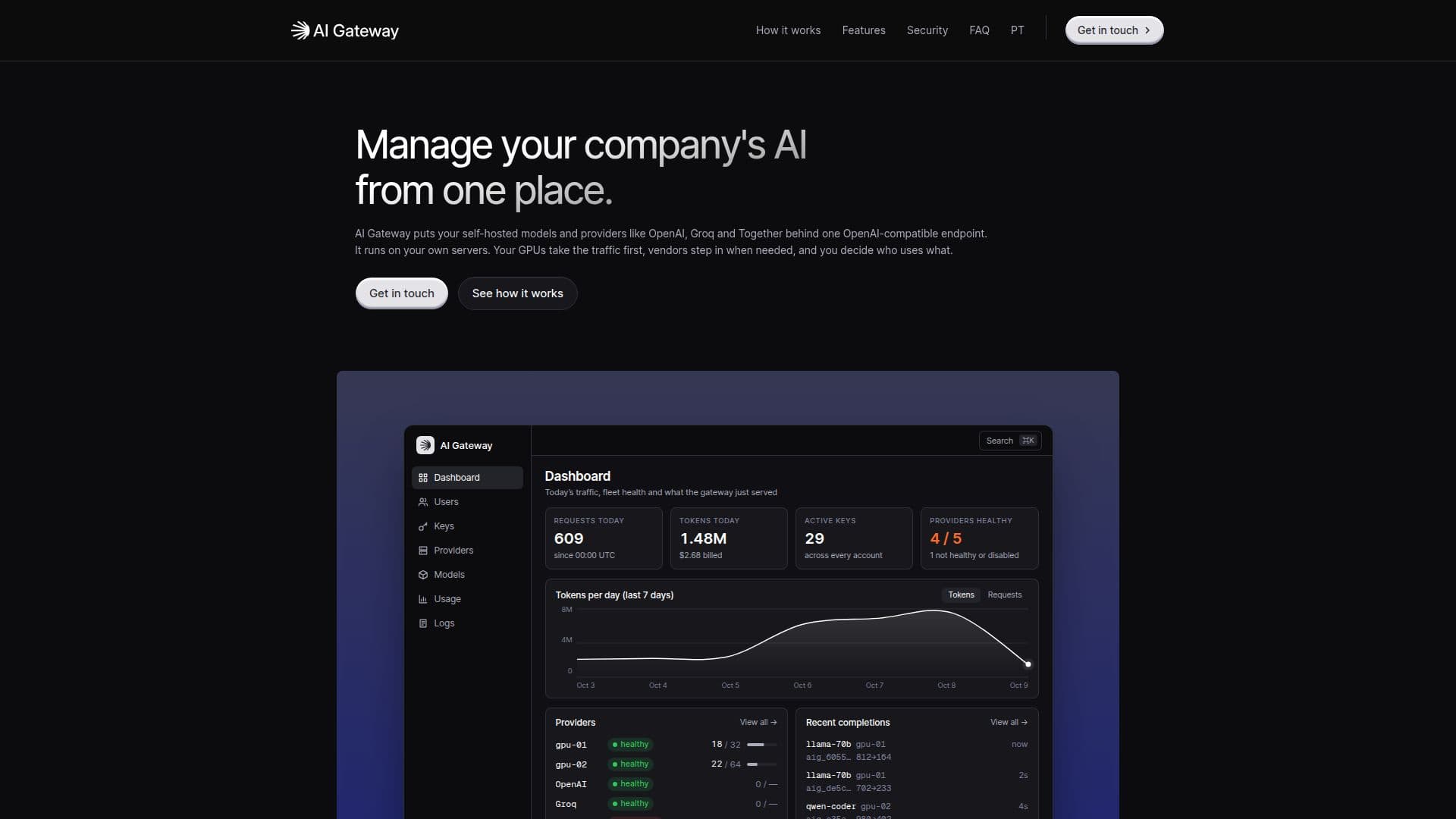
Description
LayerX AI Gateway acts as a single, OpenAI-compatible API endpoint that sits in front of your self-hosted GPU servers and various third-party AI providers. This allows applications to send all requests to one central location, where the gateway intelligently routes them, enforces predefined limits, and meticulously records associated costs. The system is designed to run within your existing infrastructure, offering full control and data sovereignty. For organizations preferring a managed solution, LayerX also provides hosting and management services.
Read More
Integration is seamless for applications already utilizing the OpenAI SDK; users only need to update the base URL and API key, with all other code remaining unchanged. The gateway supports any OpenAI-compatible provider, including major services like OpenAI, OpenRouter, Groq, and Together, alongside self-hosted solutions running vLLM or Ollama. It also facilitates access to Anthropic and Gemini models via OpenRouter.
A key feature is its robust failover mechanism. The gateway continuously monitors provider health, automatically rerouting requests to healthy alternatives if a provider is down, overloaded, or rate-limited. Unhealthy providers are temporarily removed from rotation to maintain service continuity. Privacy is paramount, as prompts and responses are never logged or stored; only usage data, such as date, model, key, and token counts, is recorded for cost analysis and reporting.
AI Gateway offers comprehensive usage control, allowing administrators to set daily and monthly token budgets for individual users, establish requests-per-minute limits for each API key, and specify which models each user can access. Costs are tracked in US dollars, providing clear financial oversight. Supported API endpoints include chat completions (with and without streaming), embeddings, and model listing. Access is managed by administrators who invite users via email, with a 6-digit code for password-less sign-in.
The deployment process involves four steps: deploying the gateway on your servers (or opting for LayerX management), connecting providers (GPU servers and vendor accounts), inviting team members with personalized access and budgets, and finally, pointing your applications to the gateway's single URL. This setup ensures that your GPUs handle traffic first, with vendors acting as automatic backups, optimizing resource utilization and cost efficiency. The dashboard provides a clear view of every token and dollar spent, making AI budget management transparent.
- CategoryAI DevOps & Cloud Tools
- Pricing ModelContact sales
- DeploymentSelf-hosted, Cloud (managed by LayerX)
- PlatformsWeb
LayerX AI Gateway's Core Features
OpenAI-compatible API for unified access
Supports self-hosted GPUs (vLLM, Ollama) and third-party vendors (OpenAI, Groq, Together, OpenRouter)
Automatic failover and load balancing across providers
Per-user daily and monthly token budgets
Requests-per-minute limits per API key
Admin-controlled model access per user
Prompts and responses are never stored or logged
Usage and cost tracking in US dollars
Supports chat completions (streaming and non-streaming), embeddings, and model listing
Easy integration with existing OpenAI SDK code (change base URL and API key)
Runs on your own servers or managed by LayerX
Private by design, only usage data recorded
Centralized management of AI resources
Real-time provider health checks
GDPR compliant
How to use LayerX AI Gateway?
Deploy AI Gateway: Install the gateway on your own servers or opt for LayerX's managed hosting service.
Connect Providers: Register your GPU servers (vLLM, Ollama) and third-party vendor accounts, naming models for team recognition.
Invite Team Members: Send invitations to team members, assigning individual API keys, token budgets, and allowed models.
Point Applications: Update your applications to direct requests to the AI Gateway's single URL, enabling automatic routing and cost tracking.
LayerX AI Gateway's Use Cases
- Unified LLM Access
- Cost Tracking & Reporting
- Automated Failover
- User Quota Management
- Model Access Control
- GPU First Routing
- Data Privacy Compliance
- Simplified AI Integration