
Description
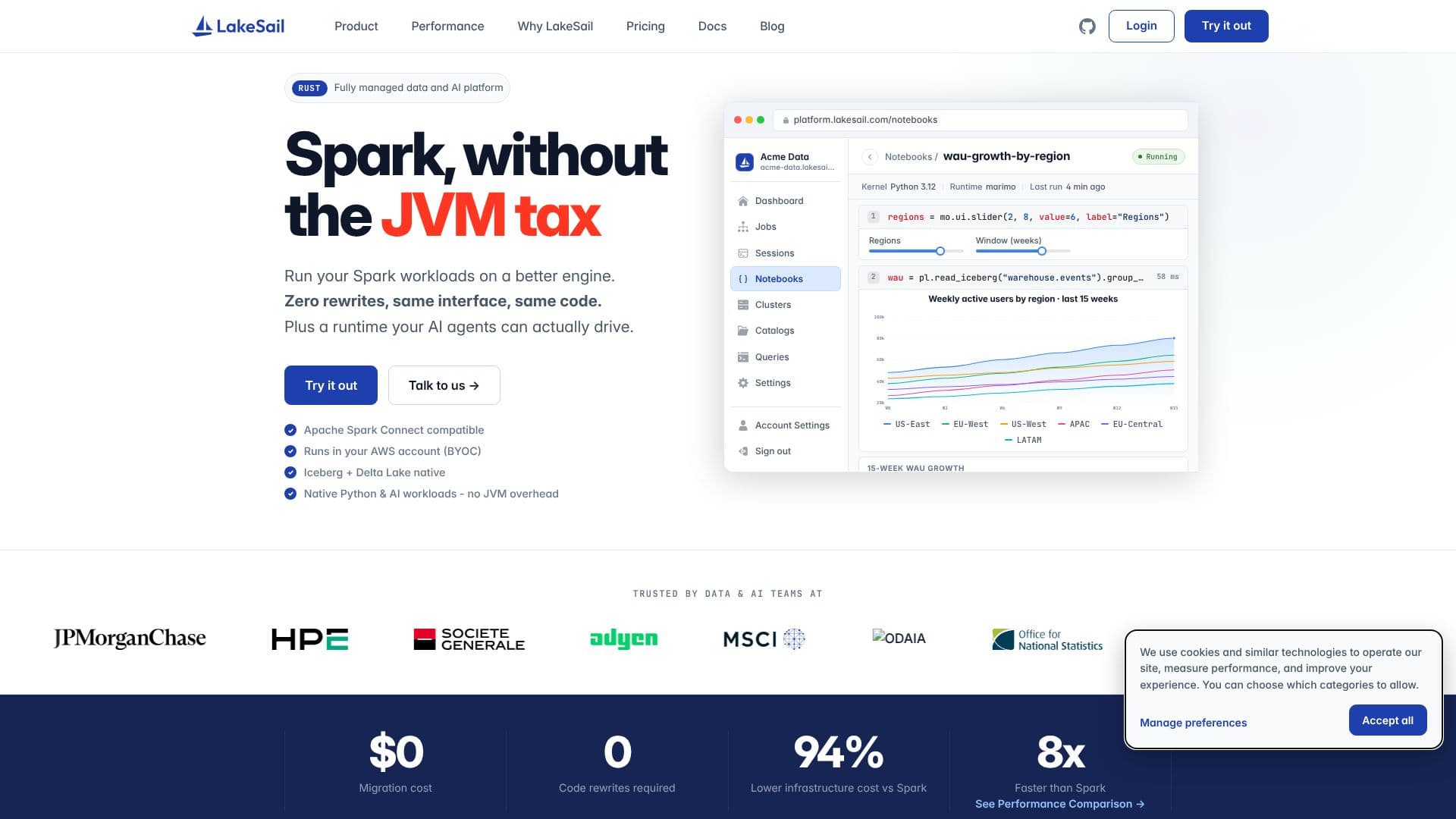
LakeSail is a next-generation data and AI platform built from the ground up in Rust, offering a significant performance upgrade over traditional JVM-based data engines. It is designed to be a drop-in replacement for Apache Spark, meaning existing PySpark, Spark SQL, Delta Lake, and Iceberg code can run unchanged. This zero-migration-cost approach allows data teams to leverage a dramatically faster and more cost-effective engine with a single configuration change.
Read More
The platform's core innovation lies in its Rust-native runtime, which eliminates the overhead associated with the Java Virtual Machine (JVM). This results in instant startup times, no garbage collection pauses, and reduced memory tuning requirements. LakeSail's stateless Rust runtime scales efficiently, even to zero, minimizing idle costs. It provides native Python performance at the engine's speed, bypassing the serialization tax often incurred when Python workloads interact with JVM-based systems.
Built for the agentic era, LakeSail integrates AI capabilities from its inception. It features an MCP server, dynamic Python tooling, and lakehouse branching, creating a substrate where AI agents can operate with enhanced sandboxing, observability, and reversibility. This contrasts with platforms that retrofit AI onto older architectures. LakeSail supports open formats like Iceberg and Delta Lake, and integrates with Spark Connect and DataFusion, ensuring broad compatibility.
The value proposition of LakeSail is clear: achieve superior performance and cost savings without the pain of refactoring existing data pipelines. The platform promises 8x faster query speeds and 94% lower infrastructure costs compared to JVM-based Spark. It consolidates batch, streaming, ad hoc SQL, and AI agent workloads into a single engine, simplifying data architecture. Furthermore, LakeSail eliminates vendor lock-in contracts and minimum spend requirements, offering true autoscaling to zero.
LakeSail is ideal for data engineering teams, AI/ML engineers, and data scientists who are looking to optimize their data infrastructure for both performance and cost. It's particularly beneficial for organizations heavily invested in Spark ecosystems that are seeking to modernize their stack without extensive engineering effort. The platform's agent-first design also makes it a compelling choice for teams developing and deploying AI-driven applications.
- CategoryMachine Learning Platforms
- Pricing ModelCustom
- DeploymentCloud
- PlatformsWeb
LakeSail's Core Features
Rust-native data and AI runtime
Drop-in replacement for Apache Spark
Full Spark API compatibility (PySpark, Spark SQL, Delta Lake, Iceberg)
8x faster query speeds compared to Spark
94% lower infrastructure costs than JVM-based Spark
Zero code rewrites required for migration
Agent-first architecture with MCP server
Sandboxed, observable, and reversible agent actions
Lakehouse branching capabilities
Sub-second cold starts
No JVM tax (instant startup, no GC pauses)
Stateless Rust runtime that scales to zero
Native Python at engine speed
Supports open formats (Iceberg, Delta Lake)
Integrates with Spark Connect and DataFusion
How to use LakeSail?
Configure: Update your data pipeline configuration to point to LakeSail.
Connect: Establish connections using Spark Connect protocol.
Run: Execute your existing PySpark, Spark SQL, Delta Lake, and Iceberg code.
Observe: Monitor performance improvements and cost reductions.
Integrate AI: Leverage the agent-first substrate for AI applications.
LakeSail's Use Cases
- Spark Replacement
- AI Agent Development
- Data Engineering
- Ad Hoc SQL Queries
- Lakehouse Modernization
- Cost Optimization