
Description
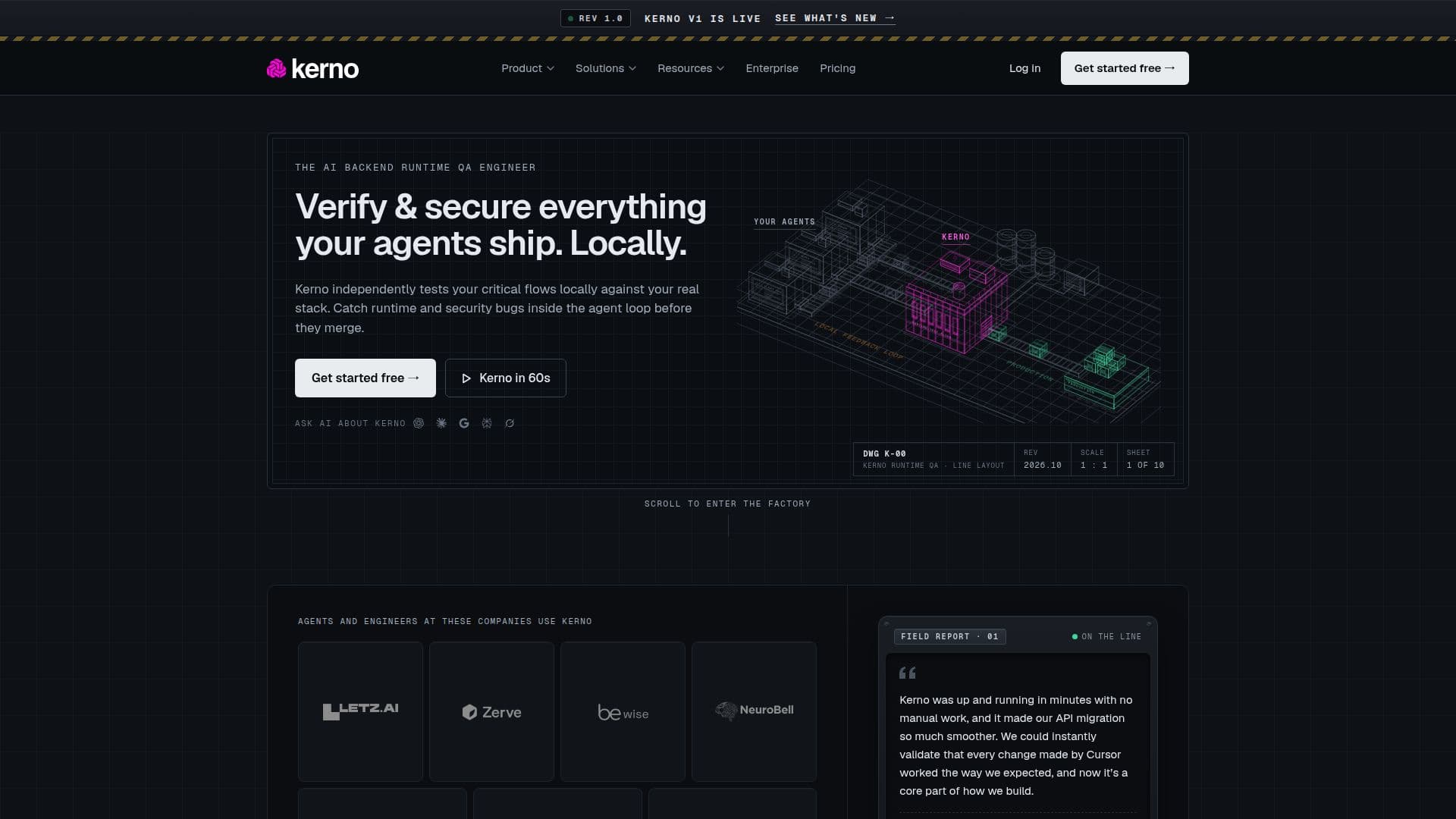
Kerno functions as an AI Backend Runtime QA Engineer, designed to operate within every coding session. It rigorously tests your running application and its real dependencies, identifying regressions and security vulnerabilities that often elude conventional code review processes and even AI-generated tests. By integrating into your coding agent's loop, Kerno ensures that runtime and security bugs are detected and addressed before any code changes are merged.
Read More
The platform focuses on end-to-end testing of critical user flows against your live stack. This includes verifying HTTP APIs, MCP tools, background tasks, and message queues. Unlike static analysis, which reads code, or unit tests that rely on mocks, Kerno executes your actual code against your live environment, enabling it to uncover runtime behaviors that other methods cannot.
Kerno is compatible with various coding agents, connecting via MCP to tools like Claude Code, Codex, Cursor, and GitHub Copilot. Security is a core aspect of its design; Kerno encrypts all data end-to-end, never retains your code, and explicitly states that private code is not stored or used for training. A SOC 2 Type 2 audit is currently in progress to further validate its security posture.
The testing process involves several steps: mapping your codebase and critical user flows, testing each user flow as a complete journey across your APIs, verifying the full impact of changes by re-running affected flows, and self-healing by updating entry-point tests as your product evolves. Kerno generates functional and on-demand security scenarios, including those mapped to OWASP API and Web Top 10. It can also verify side effects like database writes, queued messages, and downstream calls when connected to dependencies.
Kerno supports a wide array of backend languages and frameworks, including TypeScript, Python, Go, Rust, Ruby, PHP, C#, Java, Kotlin, and Scala. It offers both black-box testing over HTTP and white-box testing with direct database access. The system learns your business logic, conventions, and standards, applying them to every change and improving its accuracy through feedback from each test run. Pricing includes a free Community plan with 30 test runs per month, a Pro plan for teams with unlimited runs, and an Enterprise plan offering advanced features like SSO, self-hosting, and dedicated support. Discounts are available for qualified open-source projects and early-stage startups.
- CategoryAI Code Review & Testing
- Pricing ModelFreemium
- DeploymentCloud, Self-host (Enterprise)
- PlatformsWeb
Kerno's Core Features
AI Backend Runtime QA Engineer
End-to-end critical user flow testing
Tests against live application and real dependencies
Catches runtime regressions and security issues
Integrates with coding agents (e.g., Claude Code, GitHub Copilot)
Encrypts data end-to-end and never retains code
Maps codebase, entry points, and critical user flows
Verifies HTTP APIs, MCP tools, background tasks, and message queues
Generates functional and OWASP Top 10 security scenarios
Supports major backend languages (TypeScript, Python, Go, Rust, Ruby, PHP, C#, Java, Kotlin, Scala)
Offers black-box and white-box testing
Learns business logic and standards from feedback
CI integration for pull request verification
Provides detailed run reports with failure pinpointing
Self-heals and evolves tests with code changes
How to use Kerno?
Install Kerno: Point Kerno at your repository to begin mapping your codebase and critical user flows.
Map Critical Flows: Work with your coding agent to define and confirm the essential user journeys for testing.
Test User Flows: Kerno plans and runs tests for each critical user flow and its underlying entry points against your live services.
Verify Changes: Re-run affected flows before opening a pull request and again in CI to verify the impact of code changes.
Review Reports: Examine detailed run reports that pinpoint failures, showing the exact step, request, and response.
Integrate with CI: Use the Kerno GitHub Action or Docker image to automate test replays on every pull request.
Kerno's Use Cases
- Runtime Backend QA
- End-to-End User Flow Testing
- API Migration Validation
- Security Vulnerability Detection
- CI/CD Integration
- Agent-Assisted Development
- Background Task Testing
- Contract & Schema Validation
- Authorization & Authentication Testing
- Monorepo Testing