Description
The Interop Ops Agent is a sophisticated system engineered to streamline and automate the complex processes involved in healthcare data interoperability. It acts as an intelligent intermediary, processing incoming messages and applying a series of checks and transformations to ensure data quality and compliance. The system operates by running cases every 30 seconds for all visitors, demonstrating its real-time processing capabilities.
Read More
Core functionalities include automated code mapping, where it can translate proprietary codes (e.g., SOD) to standardized ones (e.g., LOINC 2951-2). It also performs unit conversions, such as transforming creatinine values from mg/dL to umol/L or glucose from mg/dL to mmol/L, based on predefined multipliers and analyte-specific rules. The agent is adept at identifying and handling various data anomalies, including duplicate messages, prompt injections, and unknown codes, routing them for appropriate action like quarantine or escalation.
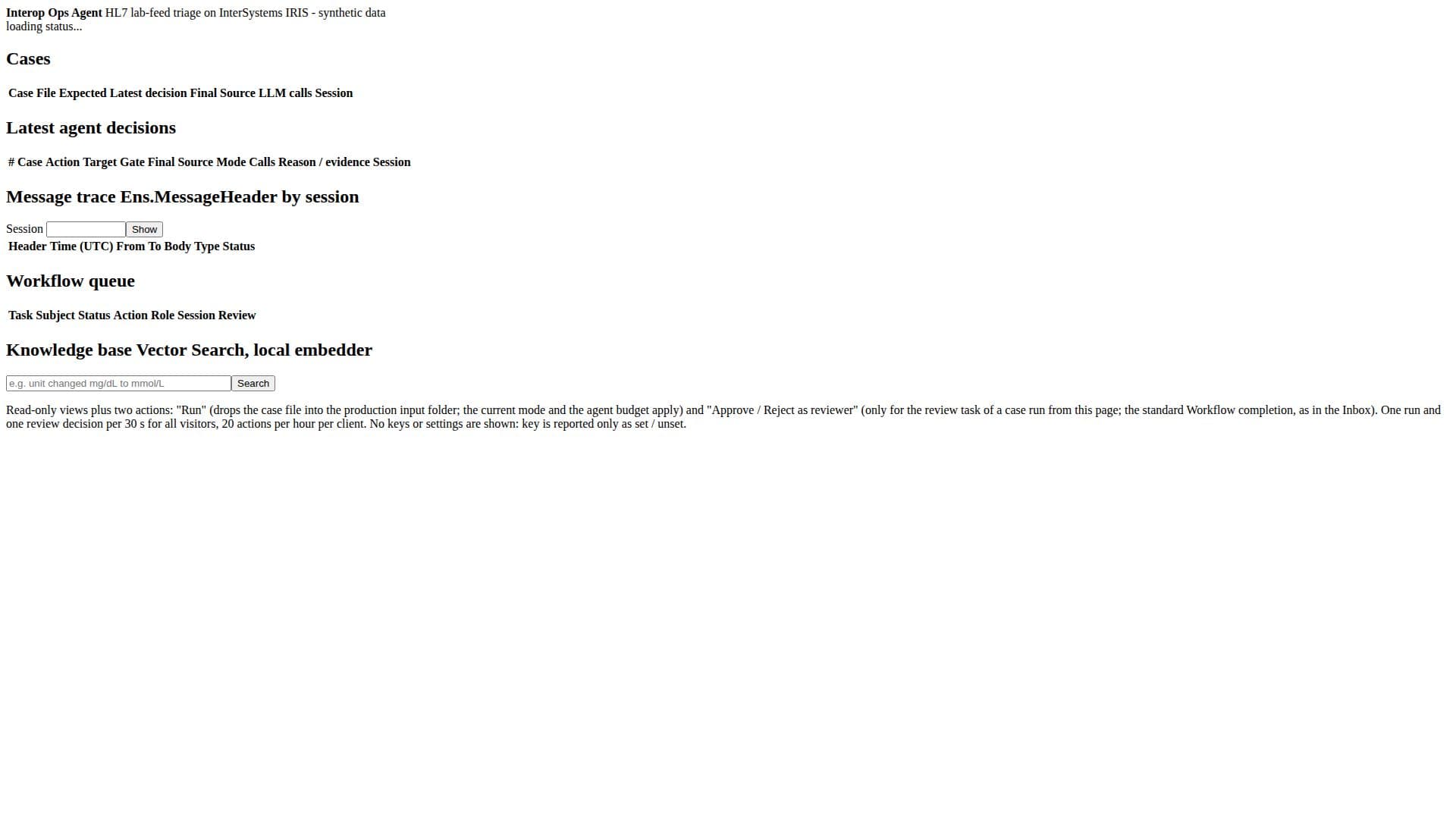
Each decision made by the agent is meticulously traced, providing a comprehensive message header history that details the flow of information between different internal components like IOA.In.CaseFile, IOA.Process.Message, and IOA.Agent. This transparency is crucial for auditing and understanding the agent's reasoning. The system incorporates a knowledge base with vector search capabilities and a local embedder, allowing it to reference and apply established rules and evidence, such as UCUM normalization for units or specific conversion factors.
A key aspect of the Interop Ops Agent is its workflow queue, which manages tasks and flags items requiring human review. For instance, if the agent proposes a patch mapping, it undergoes a gate check that verifies consistency across units, values, and specimen types against historical data. The system provides a detailed summary of what the gate checked and what the proposer (the agent) says, including evidence and reasoning, before a final decision is made by a reviewer.
This robust system is designed to reduce manual intervention in data processing, minimize errors, and accelerate the flow of accurate healthcare information. It supports critical functions like checking for critical values and ensuring that data transformations align with clinical expectations and reference ranges. The Interop Ops Agent aims to enhance the reliability and efficiency of data exchange within healthcare environments.
- CategoryMedical & Clinical AI
- Pricing ModelFree Demo
- DeploymentCloud
- PlatformsWeb
Interop Ops Agent's Core Features
Automated Code Mapping: Translates proprietary codes to standardized LOINC codes.
Unit Conversion: Automatically converts units like mg/dL to umol/L or mmol/L.
Anomaly Detection: Identifies and handles issues like duplicate messages and unknown codes.
Message Traceability: Provides detailed history of agent decisions and message flow.
Workflow Queue Management: Manages tasks and flags items for human review.
Knowledge Base Integration: Utilizes vector search and local embedder for rule application.
Gate Checks for Decisions: Verifies proposed changes against historical data and rules.
Critical Value Checking: Ensures data aligns with clinical expectations and reference ranges.
Real-time Case Processing: Runs cases every 30 seconds for continuous operation.
Evidence-Based Reasoning: Provides reasons and evidence for agent decisions.
UCUM Normalization: Standardizes unit representations for consistency.
Automated Escalation: Routes complex or unhandled cases for human intervention.
Deterministic Processing: Ensures consistent outcomes for identical inputs.
Reviewer Notification: Informs human reviewers about pending decisions and tasks.
How to use Interop Ops Agent?
Monitor Cases: Observe the 'Cases' dashboard to see real-time processing and outcomes.
Review Decisions: Check 'Latest agent decisions' and 'Message trace' for detailed insights into agent actions.
Examine Workflow Queue: Access the 'Workflow queue' to see tasks requiring attention or approval.
Utilize Knowledge Base: Use 'Knowledge base Vector Search' to understand the rules and evidence applied by the agent.
Approve/Reject Proposals: For cases marked 'pending_review', evaluate the agent's proposal and evidence before approving or rejecting.
Understand Unit Conversions: Refer to knowledge base entries like 'kb-creatinine-units' or 'kb-glucose-units' for specific conversion logic.
Interop Ops Agent's Use Cases
- Automated Code Mapping
- Unit Conversion Automation
- Anomaly Detection in Messages
- Workflow Management for Data Review
- Data Quality Assurance
- Interoperability Message Processing
- Historical Data Validation
- Clinical Data Standardization
- Reducing Manual Data Entry Errors
- Compliance with Data Standards