Description
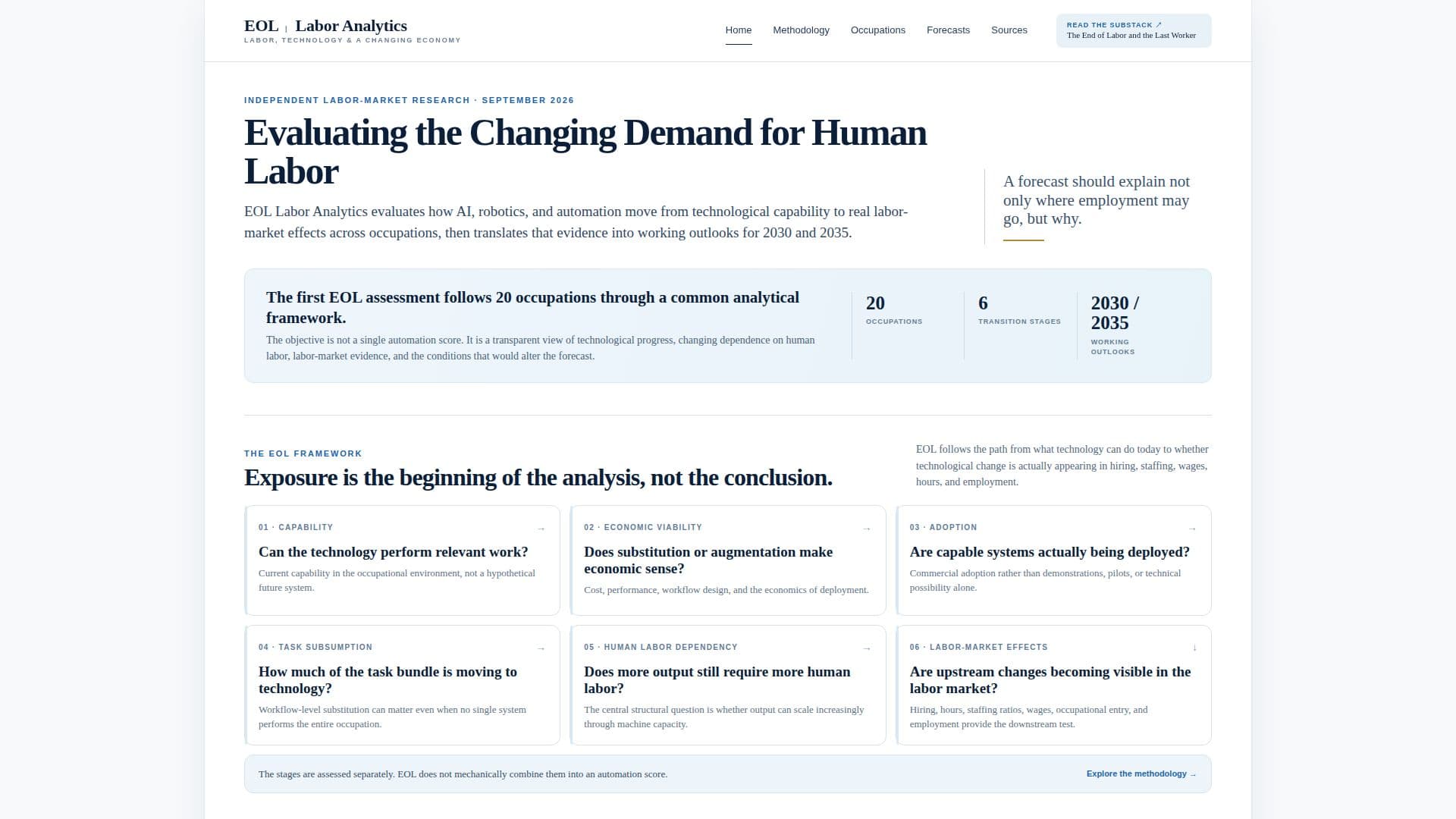
EOL Labor Analytics is an independent, non-commercial research project that examines how AI, robotics, and automation may alter the demand for human labor in the United States by 2030 and 2035. The platform evaluates technological capabilities and their real-world effects on labor markets across various occupations. Unlike traditional methods that focus on a single automation score, EOL provides a comprehensive analysis of technological progress, labor-market evidence, and conditions that could change forecasts.
The analysis begins with assessing current technological capabilities in occupational environments and evaluates whether substitution or augmentation makes economic sense. It also examines whether capable systems are being commercially deployed and how much of the task bundle is transitioning to technology. EOL assesses whether increased output still requires more human labor and whether upstream changes are visible in the labor market.
EOL's forecasts are developed alongside the Bureau of Labor Statistics (BLS) projections, extending the sight picture when historical relationships are disrupted. The platform uses a six-stage transition assessment to form working outlooks for 2030 and 2035, considering underlying demand and observed labor-market effects. EOL also evaluates the worker pipeline for each occupation, analyzing education, licensure, training, turnover, and entry trends.
The platform provides detailed occupation-level analysis, such as for software developers, where AI capabilities are advanced but labor effects are uneven. EOL expects the demand for software developers to weaken as AI-driven productivity increases. The platform also explores broader economic, institutional, and social implications of AI and robotics transitions through its companion Substack, "The End of Labor and the Last Worker."
EOL Labor Analytics's Core Features
Evaluates AI and automation impact on labor demand
Provides transparent technological progress analysis
Uses a six-stage transition assessment
Develops forecasts alongside BLS projections
Analyzes worker pipeline for each occupation
Offers occupation-specific frameworks
Includes long-form economic and social analysis
Independent, non-commercial research project
How to use EOL Labor Analytics?
Evaluate: Assess current technological capabilities
Analyze: Examine economic sense of substitution or augmentation
Deploy: Determine commercial deployment of systems
Forecast: Develop working outlooks for 2030 and 2035
Review: Analyze worker pipeline and labor-market effects
EOL Labor Analytics's Use Cases
- Labor Demand Forecasting
- Occupational Analysis
- Economic Impact Studies
- Workforce Planning
- Policy Development