
Description
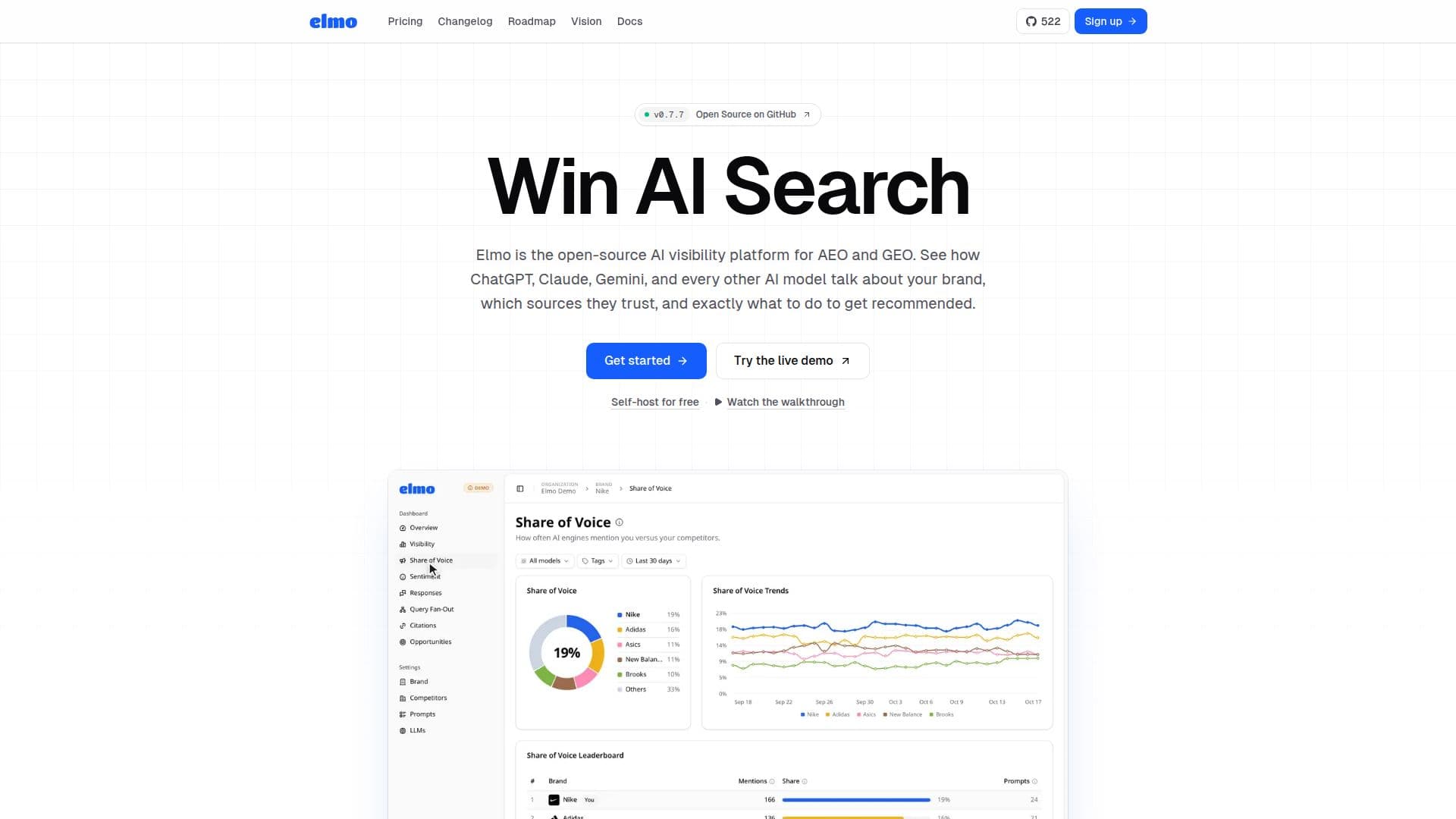
Elmo is an open-source AI visibility platform dedicated to Answer Engine Optimization (AEO), also known as Generative Engine Optimization (GEO) or LLM Optimization (LLMO). It provides a comprehensive solution for tracking and improving how AI answer engines mention and cite your brand. Unlike traditional SEO, which focuses on ranking in search results, Elmo aims to position your brand as a direct source quoted within AI-generated answers.
Read More
The platform monitors a wide array of AI models, including ChatGPT, Google AI Overviews, Gemini, Perplexity, Copilot, Claude, Grok, Mistral, DeepSeek, Qwen, and Kimi. For consumer-facing products like ChatGPT and Google AI Mode, Elmo scrapes data directly from the real user interface, ensuring accurate representation of what customers see. It records whether your brand appears in answers, which competitors are mentioned alongside, and the specific sources cited by each model.
Elmo measures AI visibility by running a fixed set of prompts across various AI engines on a scheduled basis. It scores each prompt based on brand appearance (0-100%), calculates share of voice against competitors, and performs sentiment analysis (0-100%) to determine if mentions are positive or negative. The tool also tracks the position of your brand among others named in an answer and breaks down cited domains and URLs. By repeatedly sampling AI answers, Elmo reports reliable trends rather than single, potentially variable results.
To get started, users add their website to Elmo, and its Prompt Wizard generates relevant questions buyers are likely to ask, based on products, competitors, and personas. These prompts are then run on a schedule, with every answer recorded. Elmo offers both a free, open-source self-hosting option and managed Elmo Cloud plans starting at $29/month. Cloud plans include unlimited seats, API access, and an MCP server for AI assistants. White-label solutions are also available for agencies looking to offer AI visibility tracking under their own brand.
- CategoryAI SEO Tools
- Pricing ModelFreemium
- DeploymentCloud, Self-Hosted
- PlatformsWeb
Elmo's Core Features
AI Visibility Tracking: Monitor brand mentions across multiple AI engines.
Share of Voice Analysis: Compare brand mentions against competitors.
Sentiment Analysis: Evaluate praise or criticism in AI answers (0-100 score).
Citation Tracking: Identify domains and pages cited by AI models.
Query Fan-out Analysis: Understand web searches AI engines perform behind answers.
Prompt Tracking: Organize and inspect AI answers for configured prompts.
Opportunity Identification: Generate content and pitching recommendations.
Comprehensive Reporting: Overview dashboards, chart exports, and API for BI.
Multi-Model Tracking: Supports ChatGPT, Gemini, Perplexity, Claude, Copilot, and more.
Real Interface Scraping: Scrapes consumer AI products from actual user interfaces.
API and MCP Server: REST API with TypeScript/Python SDKs and MCP for AI assistants.
Open Source: Free to self-host with full source code available on GitHub.
Self-Serve Cloud Plans: Public pricing and no sales calls for managed hosting.
Unlimited Seats: All cloud plans include unlimited team members.
White-Label Deployments: Agencies can offer tracking under their own brand.
How to use Elmo?
Add Your Brand: Point Elmo at your website to generate buyer-centric prompts and identify competitors.
Configure Prompts: Use the Prompt Wizard to create questions buyers might ask about your products and personas.
Track Visibility: Elmo runs prompts across AI engines on a schedule, recording brand mentions, competitors, and citations.
Analyze Results: View visibility scores, share of voice, sentiment, and cited sources in a unified dashboard.
Identify Opportunities: Receive recommendations for content creation, page refreshes, and sources to pitch.
Optimize Strategy: Use data-driven insights to improve your brand's presence in AI-generated answers.
Elmo's Use Cases
- Brand AI Visibility Tracking
- Competitor Benchmarking
- Content Strategy Optimization
- Sentiment Monitoring
- Citation Source Analysis
- Agency Client Reporting
- Product Recommendation Tracking
- Developer Integration
- Self-Hosted Data Control