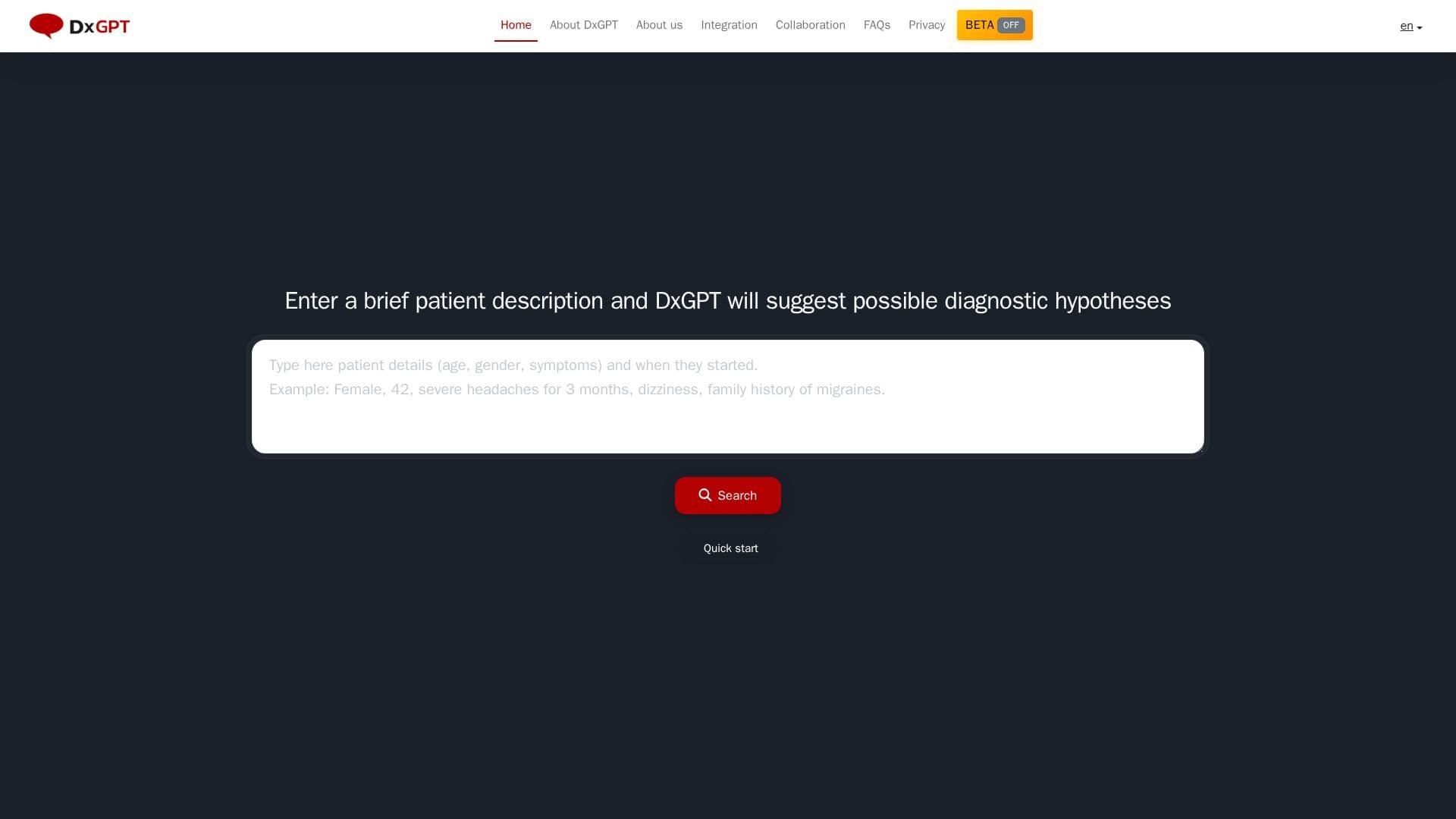
Description
DxGPT is an AI-powered diagnostic decision support software designed to assist healthcare professionals in structuring clinical descriptions into possible diagnostic hypotheses. Developed by Foundation29, a non-profit organization, DxGPT is available for free to doctors and patients worldwide. The tool leverages advanced AI models to analyze symptoms and clinical information, suggesting potential diagnostic hypotheses for professional review.
Read More
DxGPT supports both structured and unstructured clinical data input, making it versatile for various medical scenarios. It is particularly useful for diagnosing rare and genetic diseases, providing AI-powered suggestions to aid in differential diagnosis. The application is privacy-first, ensuring that all user data is encrypted, anonymized, and never sold or shared, fully complying with GDPR and HIPAA regulations.
While DxGPT is a valuable resource for healthcare professionals, it is not designed for emergency situations and should not replace professional medical judgment. The professional version of DxGPT is considered medical device software for diagnostic support and is classified as Class IIa under EU regulations.
DxGPT is accessible in virtually any language, detecting the input language and providing responses accordingly. However, users may experience minor translation nuances in less common languages. The tool is funded through donations and grants, ensuring that AI diagnostic support remains freely available to healthcare professionals and patients globally.
- CategoryMedical & Clinical AI
- Pricing ModelFree
- DeploymentCloud
- PlatformsWeb
DxGPT Diagnostic Support Tool's Core Features
AI-powered diagnostic support
Support for rare and genetic diseases
Structured and unstructured data input
Free access for doctors and patients
Privacy-first with GDPR and HIPAA compliance
Language detection and multilingual support
Class IIa medical device classification
Non-profit development by Foundation29
How to use DxGPT Diagnostic Support Tool?
Input clinical data: Enter structured or unstructured clinical information
Analyze symptoms: Use AI to analyze symptoms and data
Review hypotheses: Receive AI-generated diagnostic hypotheses
Make decisions: Use hypotheses to support professional judgment
DxGPT Diagnostic Support Tool's Use Cases
- Differential Diagnosis
- Rare Disease Diagnosis
- Clinical Data Analysis
- Multilingual Support
- Privacy-First Healthcare