Description
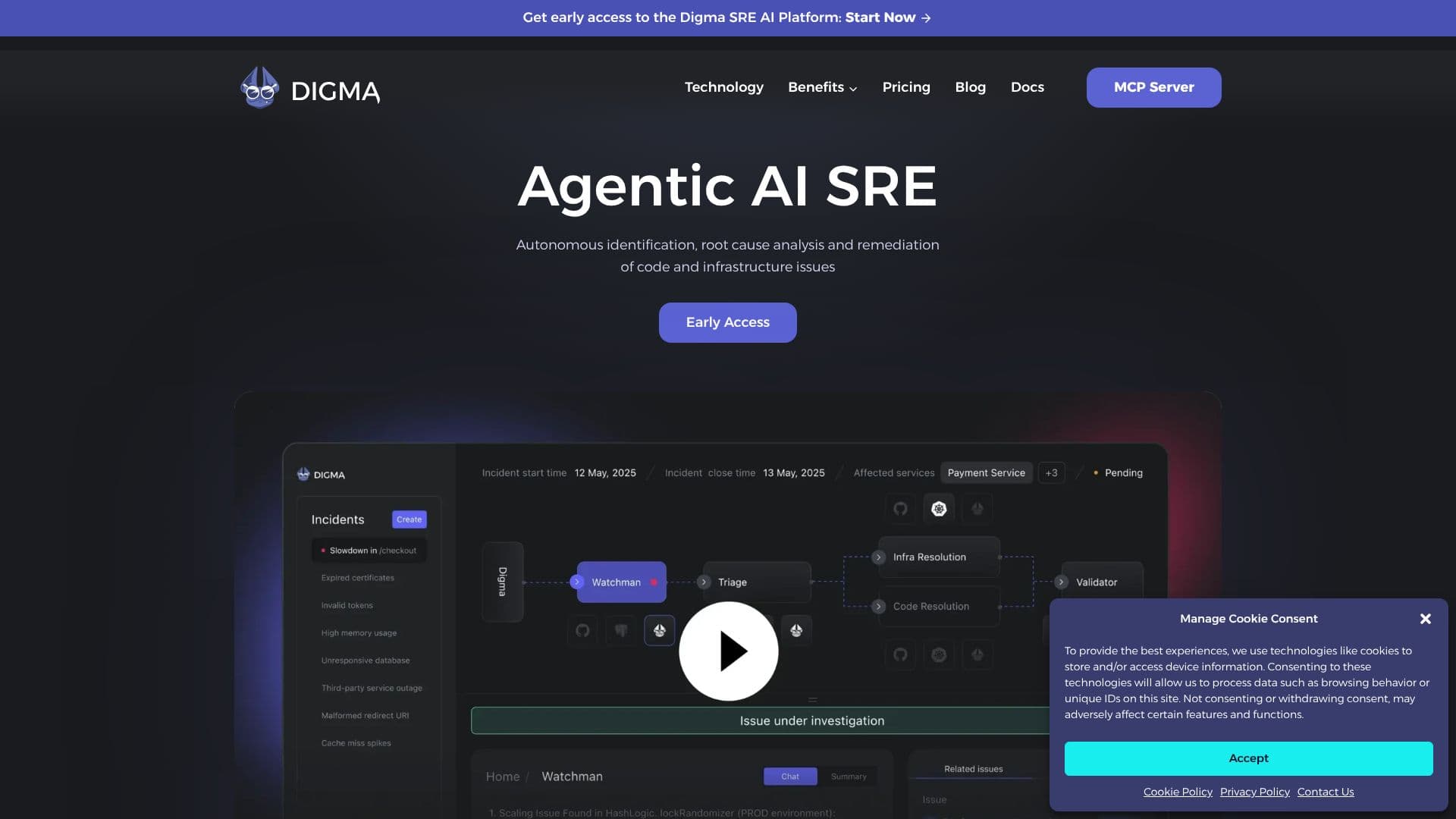
Digma's agentic AI SRE offers a fully autonomous approach to managing software reliability. It operates by identifying issues at both the code and infrastructure levels, performing deep root cause analysis, and then proposing actionable remediation steps. This can include generating pull requests for code changes or suggesting configuration updates for infrastructure.
Read More
The platform connects to existing observability stacks and key data sources such as PostgreSQL, GitHub, and Kubernetes. This integration allows Digma to gather comprehensive data for precise root cause analysis and to deliver trusted, continuous fixes. By proactively identifying and prioritizing issues based on their real impact, Digma aims to prevent problems before they escalate and affect production environments.
At its core, Digma is powered by a Dynamic Code Analysis (DCA) engine. This engine is designed to understand system behavior in real-time, processing raw observability data to reveal critical, actionable insights. This reduces the manual effort required to translate complex data into practical solutions. Furthermore, Digma's MCP server enhances code reviews by identifying runtime issues in staging and production environments, highlighting performance bottlenecks, scaling issues, and slow database queries.
Digma's AI SRE is designed to complement, not replace, traditional monitoring tools like APMs. While APMs focus on detecting issues in production, Digma identifies problems earlier in the development cycle. It works without requiring code changes and is OpenTelemetry compliant, integrating seamlessly with existing observability tools. The platform also helps reduce infrastructure costs by identifying inefficient code patterns that increase resource consumption, leading to more cost-efficient and scalable code.
Digma ensures data privacy by not using public AI models that could share data outside the organization, keeping all observability data local and under user control. It detects a variety of performance issues, including regressions introduced by code changes, slow execution paths, scalability bottlenecks, and inefficient database queries or API calls. Digma's capabilities extend beyond traditional profilers and static analysis tools by analyzing real runtime data to detect issues that these tools cannot.
- CategoryAI DevOps & Cloud Tools
- Pricing ModelFreemium
- DeploymentCloud
- PlatformsWeb
Digma AI SRE's Core Features
Autonomous identification of code and infrastructure issues
Root cause analysis for identified problems
Automated remediation proposals (e.g., PRs, config updates)
Integration with observability stacks
Connection to data sources like PostgreSQL, GitHub, Kubernetes
Proactive issue identification and prioritization
Dynamic Code Analysis (DCA) engine for real-time behavior understanding
MCP server for enhanced code reviews
Identification of performance bottlenecks and scaling issues
Suggestion of safe, smart, and production-aware fixes
Prevention of breaking changes across services
OpenTelemetry compliance for seamless integration
Cost reduction through identification of inefficient code patterns
How to use Digma AI SRE?
Connect: Integrate Digma with your observability stack and data sources.
Analyze: Digma's AI SRE autonomously identifies and analyzes code and infrastructure issues.
Diagnose: Pinpoint the root cause of identified problems.
Remediate: Receive proposed fixes, such as pull requests or configuration changes.
Optimize: Implement suggested changes to improve performance and prevent future issues.
Digma AI SRE's Use Cases
- Proactive Issue Detection
- Root Cause Analysis
- Automated Remediation
- Performance Optimization
- Code Review Enhancement
- Prevent Breaking Changes
- Infrastructure Reliability
- Cost Efficiency