Description
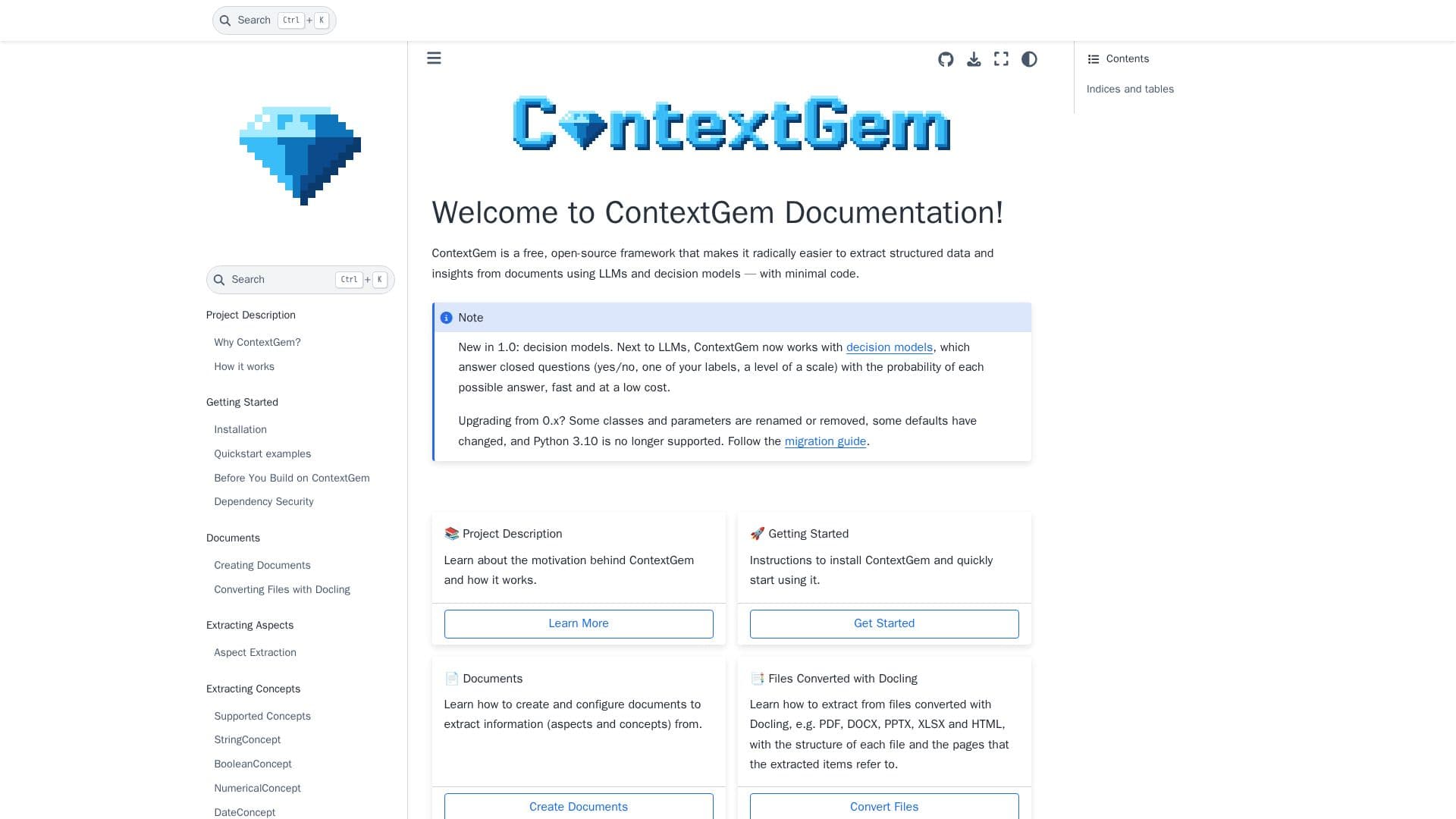
ContextGem is a free, open-source framework that simplifies the extraction of structured data and insights from documents using Large Language Models (LLMs) and decision models. It is built for in-depth analysis of individual documents, ensuring that every paragraph is read to avoid missing facts, unlike Retrieval-Augmented Generation (RAG) approaches that might struggle with complex concepts due to retrieval inconsistencies.
Read More
The framework's core components include Documents, Aspects, and Concepts. A Document can contain text and/or visual content from various sources like contracts, invoices, CVs, or general documents. Aspects represent defined areas or topics within a document, allowing for granular extraction with hierarchical sub-aspects. Concepts are units of information or entities derived from aspects or the broader document context, ranging from factual extractions like penalty clauses to analytical insights, reasoned conclusions, and interpretative judgments. ContextGem supports multiple concept types, including StringConcept, BooleanConcept, NumericalConcept, DateConcept, JsonObjectConcept, RatingConcept, and LabelConcept.
ContextGem offers flexible extraction workflows using different model types. The DocumentLLM allows a single configurable LLM to extract all aspects and concepts, including multimodal content if the model supports vision. It also supports fallback models for robustness. The DocumentDecisionModel is designed for closed questions (yes/no, pick one option, rate on a scale), providing probabilities for each possible answer without generating text, making it fast and cost-effective for specific concept types. For more complex scenarios, the DocumentModelGroup enables the use of multiple models with unique roles, allowing different LLMs or decision models to handle specific aspects or concepts based on their complexity or type.
The framework is designed to integrate into agentic workflows at three key points: at document ingestion for metadata extraction, as a tool for on-demand extraction by an agent, and at decision points where a decision model can answer closed questions to guide the workflow. ContextGem emphasizes cost optimization through strategies like selecting cost-efficient models, using decision models for closed questions, leveraging default parameters, enabling justifications only when necessary, and monitoring usage and cost. It also provides robust security practices, including dependency pinning, delayed adoption of new releases, and checks against known advisories to mitigate supply-chain risks.
- CategoryNatural Language Processing Tools
- Pricing ModelFree
- DeploymentSelf-hosted
- PlatformsWeb
ContextGem's Core Features
Structured data extraction from documents
Leverages LLMs for open-ended extraction
Utilizes decision models for closed questions (yes/no, labels, ratings)
Supports various document types (PDF, DOCX, PPTX, XLSX, HTML)
Extracts specific document sections using Aspects API
Infers structured data like JSON, strings, numbers, dates, booleans with Concepts API
Builds reusable extraction pipelines
Configurable LLM providers and local models
Optimizes extraction for accuracy, cost, and performance
Serialization and deserialization of ContextGem objects
Integration with agentic workflows
Detailed API documentation
Open-source framework
Cost optimization strategies
Dependency security practices
How to use ContextGem?
Install ContextGem: Follow instructions to set up the framework.
Create Documents: Configure documents for information extraction.
Convert Files: Process files like PDF, DOCX, PPTX, XLSX, and HTML.
Extract Aspects: Identify and extract specific document sections.
Extract Concepts: Infer structured data like JSON, strings, numbers, and dates.
Build Pipelines: Create reusable extraction pipelines for consistent analysis.
Explore Models: Configure and use supported cloud LLM providers and local models.
Optimize Extraction: Implement strategies for cost and performance efficiency.
ContextGem's Use Cases
- Contract Analysis
- Invoice Processing
- Resume Parsing
- Medical Research Data Extraction
- Financial Report Analysis
- Technical Document Review
- HR Policy Extraction
- Document Metadata Extraction
- Agent Tool Integration
- Workflow Decision Making