
Description
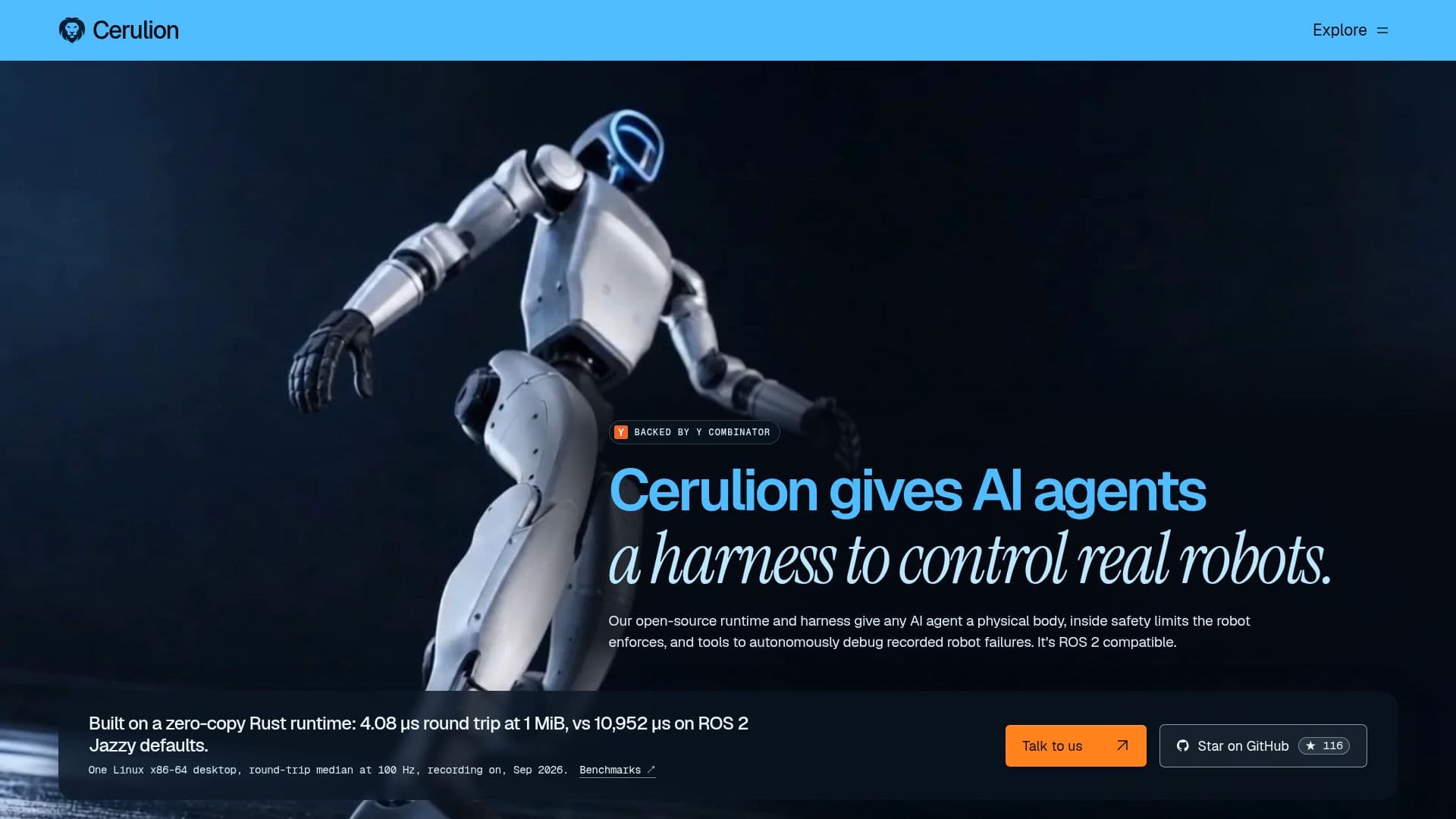
Cerulion is an open-source operating system designed for physical AI, enabling AI agents to control real robots with enhanced safety and debugging capabilities. Its core offering includes an open-source runtime and harness that provides any AI agent with a physical body, operating within safety limits enforced by the robot itself. This system is fully compatible with ROS 2, making it accessible for existing robotics ecosystems.
Read More
Built on a zero-copy Rust runtime, Cerulion boasts significantly faster round-trip times compared to ROS 2 Jazzy defaults, achieving 4.08 μs at 1 MiB versus 10,952 μs. This performance ensures efficient and responsive control over robotic systems. The `cerulion-rcpd` component acts as an MCP server on the robot, where agents can only call tools explicitly declared in `rcp.yaml`. The robot rigorously checks argument limits, safety classes, and an e-stop latch for every call, maintaining a detailed receipt for accountability and safety.
A key feature is Flashback, which allows users to keep the moments around a robot failure. Flashback automatically saves recent robot history as MCAP files on a runtime fault or on demand, providing crucial data for post-incident analysis. This is complemented by Hindsight (early access) and Studio, which help pinpoint the exact moment of failure and visualize the relevant frames from recorded telemetry.
Cerulion also supports debugging recorded failures and comparing native outputs. Users can re-run supported native recordings with new code and the same inputs, with the system identifying topics that have changed. This capability is integrated into CI workflows, allowing for automated verification of robot runs against set tolerances. The platform also facilitates debugging robot recordings with an AI agent, connecting Hindsight to models like Claude Code, Codex, or Cursor to ask why an MCAP recording went wrong and receive answers cited to specific topics and timestamps. This comprehensive suite of tools makes Cerulion a robust solution for developing, deploying, and maintaining AI-controlled robotic systems.
- CategoryRobotics & AI Hardware
- Pricing ModelOpen Source
- DeploymentOn-robot server (cerulion-rcpd)
- PlatformsLinux, macOS
Cerulion's Core Features
Open-source runtime and harness for AI agents
Enables AI agents to control real robots
Enforces safety limits on robot actions
Provides tools for autonomous debugging of robot failures
ROS 2 compatible operating system
Zero-copy Rust runtime for high performance (4.08 μs round trip at 1 MiB)
MCP server (`cerulion-rcpd`) for controlled agent-robot interaction
Robot checks argument limits, safety classes, and e-stop latch
Flashback saves recent robot history as MCAP on fault or on demand
Hindsight (early access) and Studio for failure analysis
Re-run supported native recordings with new code and same inputs
Compare native outputs in CI with set tolerances
Debug robot recordings with AI agents (e.g., Claude Code, Codex, Cursor)
Answers cited to topics and timestamps for debugging
Ergonomic node API for development
How to use Cerulion?
Install Cerulion: Set up the open-source runtime on Linux or macOS.
Integrate Agent: Connect your AI agent to the Cerulion harness to control a physical robot.
Define Tools: Declare the specific tools your agent can call in `rcp.yaml` for robot interaction.
Monitor Operations: Utilize `cerulion-rcpd` to ensure robot actions adhere to safety limits and argument checks.
Record History: Use Flashback to automatically save robot history as MCAP files during operation or on demand.
Debug Failures: Employ Hindsight and Studio to analyze recorded MCAP files and identify failure points.
Replay and Verify: Replay native Cerulion recordings in CI to compare outputs and verify code changes.
AI-Assisted Debugging: Connect Hindsight to an AI agent (e.g., Claude Code) to get cited answers on why recordings went wrong.
Cerulion's Use Cases
- AI Agent Robot Control
- Robot Failure Debugging
- Robotics Development & Testing
- Continuous Integration for Robotics
- ROS 2 System Enhancement
- Physical AI Operating System
- Safety-Critical Robot Operations