Description
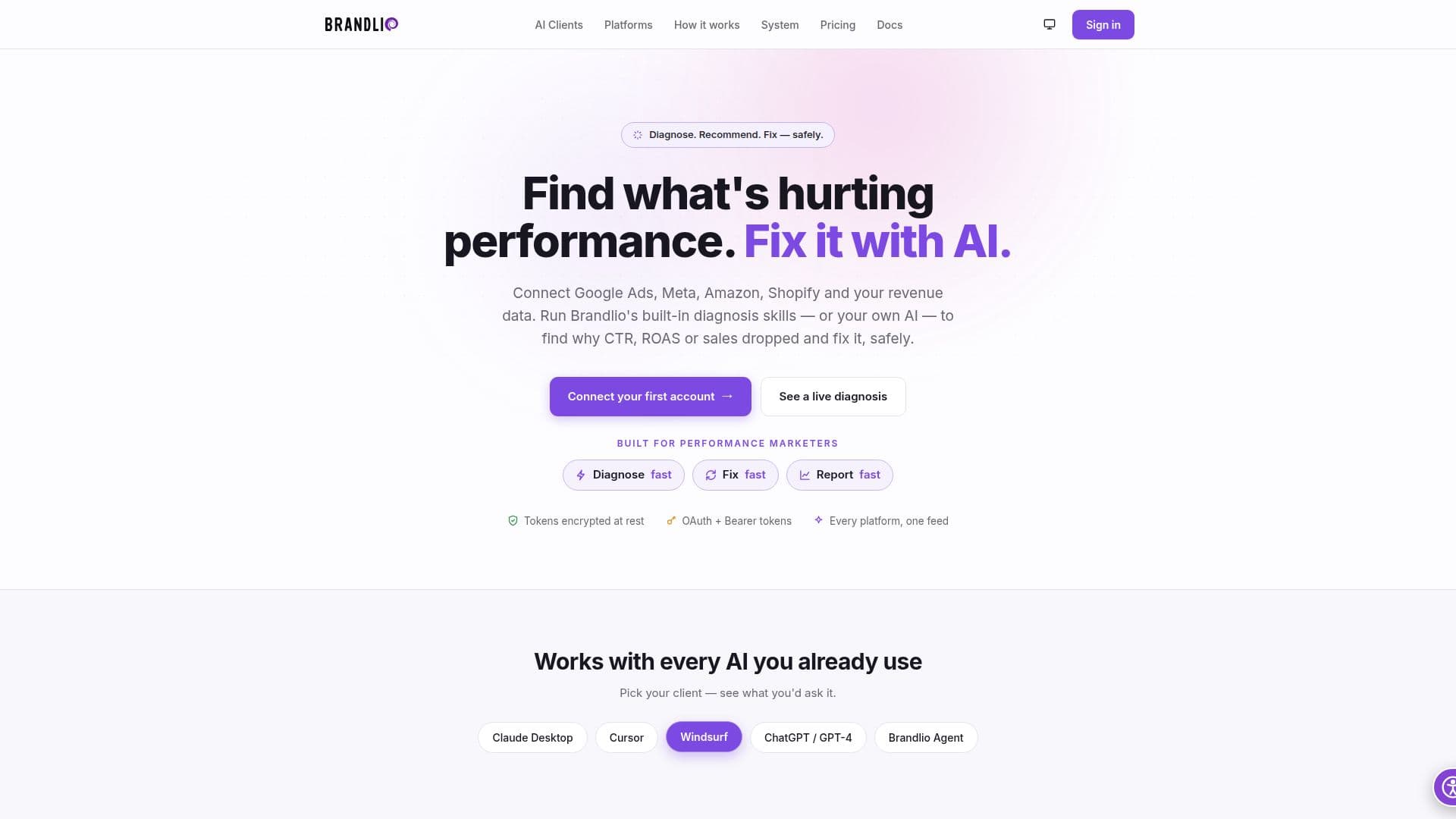
Brandlio MCP (Model Context Protocol) is a hosted server designed to bridge the gap between your marketing and commerce platforms and various AI clients. It allows users to connect accounts from Google Ads, Meta, Amazon, and Shopify, along with revenue data, to any AI. The primary purpose is to diagnose and safely fix ad performance issues.
Read More
The platform works by normalizing data, managing API tokens and limits, and delivering a clean, live feed of information directly to the AI client you are using. This ensures that your AI stops guessing and starts providing answers based on your actual numbers, eliminating the need for manual data extraction and input into AI tools.
Brandlio MCP offers two main ways to use its capabilities. First, users can connect it to their own AI clients such as Claude Desktop, Cursor, Windsurf, or ChatGPT. This setup provides the AI with live access to all connected accounts, allowing users to ask questions and receive data-driven answers. Second, for those who prefer not to manage AI themselves, Brandlio offers a built-in agent with diagnosis skills. This agent monitors accounts, detects anomalies, diagnoses performance drops, and suggests fixes automatically, all without manual prompting.
The setup process is straightforward: users authenticate each platform via OAuth, which typically takes about two minutes per account with no coding required. Once connected, Brandlio is added as an MCP server in the chosen AI client, usually with a single configuration line. After authentication, the AI can immediately begin answering questions with live data from the connected accounts.
Brandlio MCP is part of a larger Brandlio system, serving as the data layer. The full system also includes capabilities for training brand signals, competitor intelligence, and operating autonomous agents for monitoring and optimization. The service is free to start, with paid plans beginning at $49 per month, offering a 30-day free trial for paid tiers. It supports a wide range of marketing and commerce platforms, exposing over 250 tools through a single, secure OAuth endpoint.
- CategoryMarketing Automation
- Pricing ModelFreemium
- DeploymentCloud
- PlatformsWeb
Brandlio MCP's Core Features
Connects Google Ads, Meta, Amazon, Shopify, and revenue data to any AI
Provides built-in diagnosis skills for ad performance issues
Compatible with AI clients like ChatGPT, Claude, Cursor, Windsurf, and Gemini
Normalizes marketing data and handles API tokens/limits
Offers a hosted remote MCP server, no self-hosting required
Supports both user-managed AI and Brandlio's autonomous agent
OAuth 2.1 with PKCE for secure authentication
Exposes 250+ tools across 20+ marketing platforms
Live reporting for campaign, keyword, creative, and placement performance
Diagnostics for anomalies, wasted spend, and feed errors
Campaign management for creating and updating ads, keywords, and audiences
Optimization features for negative keywords, bids, and budgets
Commerce and revenue data from Shopify, WooCommerce, Amazon, and Stripe
Analytics and SEO data from GA4 and Search Console
Pre-built skills/playbooks for common marketing workflows
Personal Access Tokens (PATs) for automation and headless use
How to use Brandlio MCP?
Create Account: Sign up for a Brandlio account on their website.
Connect Platforms: Authenticate your marketing and commerce accounts (e.g., Google Ads, Meta, Amazon) via OAuth in the Brandlio dashboard.
Plug into AI: Add Brandlio as an MCP server in your preferred AI client (e.g., Claude, Cursor, ChatGPT) using the provided endpoint URL.
Authenticate AI Client: Complete the browser sign-in when prompted by your AI client to link it to Brandlio.
Ask Questions: Start querying your AI client; it will now answer with live data from your connected accounts.
Run Skills: Utilize Brandlio's built-in diagnosis skills or your own AI to analyze performance and suggest fixes.
Brandlio MCP's Use Cases
- Diagnose Ad Performance Drops
- Optimize Ad Campaigns
- Generate Weekly Performance Reports
- Analyze Search Term Performance
- Monitor E-commerce Metrics
- Improve Responsive Search Ads
- Cross-Platform CAC Calculation
- Identify Wasted Ad Spend
- Centralized Marketing Data Access
- Automated Anomaly Detection