Description
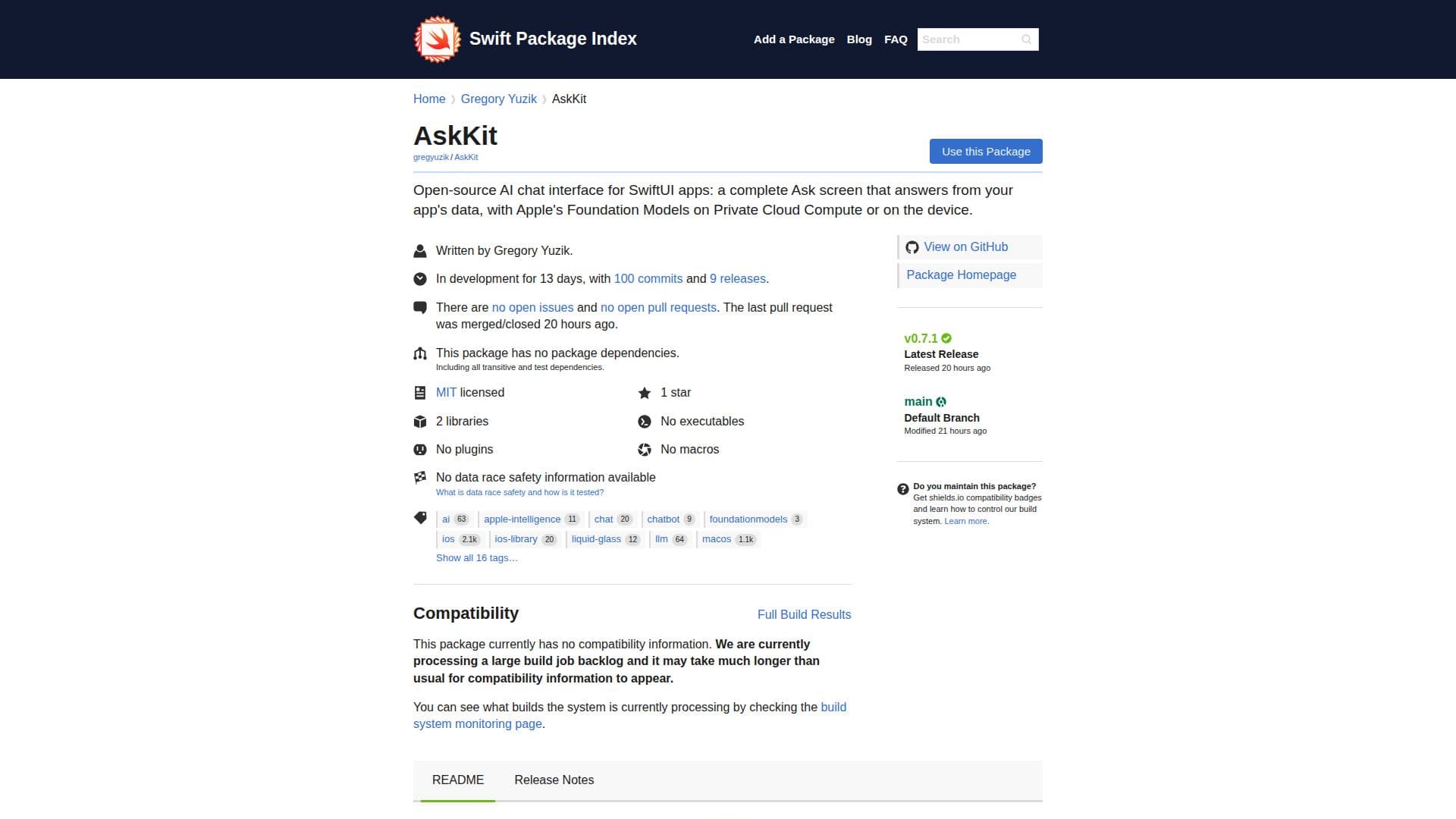
AskKit provides an open-source AI chat interface specifically tailored for SwiftUI applications, offering a comprehensive "Ask" screen that can answer questions based on an app's internal data. It integrates seamlessly with Apple's Foundation Models, supporting both on-device processing and Private Cloud Compute for enhanced privacy and performance. This allows developers to build sophisticated conversational experiences where the AI's responses are directly informed by the application's unique dataset.
Read More
The framework is designed for ease of adoption within Xcode projects, requiring developers to implement an `AskDomain` to define their app's data model, search arguments, and tools. This includes defining `AskRow` types for data entities, `@Generable` structs for search queries, and `Tool` implementations for data lookup or actions. AskKit supports various grounding policies, allowing developers to control whether answers must be grounded in app data, tool calls, or can be prose-based.
Key capabilities include robust data retrieval, where the AI can search and present relevant information from the app's data store. It also supports tool-based interactions, enabling the AI to perform actions or calculations, such as unit conversions, without relying on the app's internal rows. The framework ensures that all interactions are handled securely and privately, with options for on-device processing or utilizing Apple's Private Cloud Compute, which requires specific entitlements.
AskKit offers a customizable user interface for iOS, macOS, and visionOS, including chat history, a composer, and various display elements like evidence lines and follow-up chips. Developers can brand the interface, define starter questions, and integrate it into their app's navigation stack. The framework also includes accessibility features, multi-language support (25 languages), and robust error handling. It is built with privacy in mind, declaring no tracking or collected data, and provides a privacy manifest for AskCore.
Targeting Swift developers building applications for Apple platforms, AskKit simplifies the integration of advanced conversational AI. It empowers apps to offer intelligent, context-aware assistance, making data more accessible and interactions more intuitive for end-users. The framework's modular design allows for flexible implementation, whether the app needs to query its own data or perform tool-driven actions.
- CategoryAI Chatbot Builders
- Pricing ModelOpen Source
- DeploymentOn-device, Private Cloud Compute
- PlatformsiOS, macOS, visionOS
AskKit's Core Features
Open-source AI chat interface for SwiftUI apps
Complete "Ask" screen for iOS, macOS, and visionOS
Answers questions from your app's data
Utilizes Apple's Foundation Models
Supports Private Cloud Compute or on-device processing
Customizable `AskDomain` for data modeling and tools
Defines `AskRow` for app data entities
Supports `@Generable` structs for search arguments
Implements `Tool` for data lookup or actions
Configurable grounding policies (`.retrieval`, `.toolCall`, `.notRequired`)
Customizable UI elements: chat history, composer, evidence lines, follow-up chips
Multi-language support with 25 languages
Includes a privacy manifest for AskCore
Supports deep links to prefill the composer
Provides an engine for one-off answers outside the thread
How to use AskKit?
Add Package: Integrate AskKit from GitHub into your Xcode project, linking AskCore and AskUI products.
Implement AskDomain: Define your app's data model, search arguments, and tools by implementing the `AskDomain` protocol.
Configure Engine and Seam: Create an `AppleModelSeam` for model access and an `AskEngine` with your domain and seam.
Manage Conversation Store: Own an `AskConversationStore` at the app scope to manage chat history.
Display AskScreen: Show `AskScreen` in a `NavigationStack` within your app's UI.
Localize Strings: Put all user-facing strings into your app's String Catalog for localization.
Set Deployment Target: Ensure your deployment target is 27.2 or later for all platforms.
Build and Run: Test your implementation; development builds answer on-device until Private Cloud Compute is opted in.
AskKit's Use Cases
- In-App Data Query
- Contextual Assistant
- Unit Conversion Tool
- Knowledge Base Interaction
- Personalized Information Retrieval
- Developer Tool Integration