Description
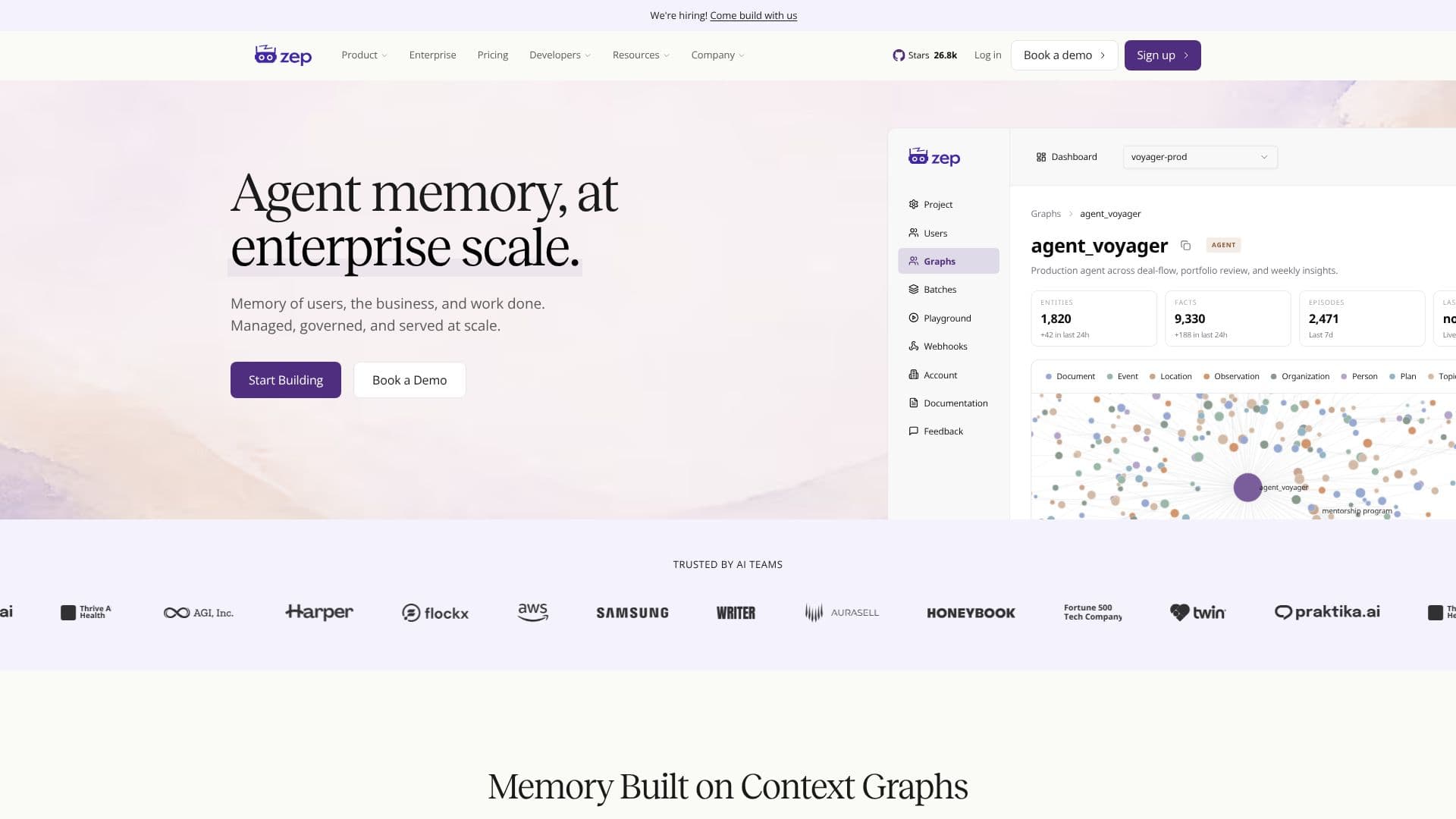
Zep is designed to address the challenges of agent memory in enterprise environments. It offers a comprehensive solution for managing and utilizing context within AI agents. The core of Zep's functionality revolves around its Context Lake, a system built to store and serve millions of context graphs. This allows agents to access and process vast amounts of information efficiently.
Read More
Zep's architecture is built on a Context Graph Engine, which constructs and manages these graphs. This engine enables the creation of memories from any source, ensuring that agents can retrieve relevant context quickly. The system supports various data types and allows for the integration of business data, user interactions, and chat history. Zep also provides features like automated context assembly and the ability to track changes over time, ensuring agents always reason with the most up-to-date information.
Key capabilities include the ability to govern context across thousands of agents, users, and context sources. Zep offers access control, retention policies, and audit trails to ensure data security and compliance. The system also provides built-in observability, including metrics on latency, error rates, and retrieval activity. Zep's performance is optimized for speed, with retrieval latency under 200 milliseconds regardless of graph size. The platform is designed to be flexible, allowing users to choose their deployment model, including managed cloud, BYOK, and BYOC options.
Zep is targeted at AI teams and enterprises looking to build reliable, personalized agents. It is particularly useful for applications requiring agents to understand and adapt to changing information. The platform's ability to surface patterns and insights from context graphs through Observations enhances agent capabilities. Zep's integration with various agent frameworks and its support for multiple programming languages make it accessible to a wide range of developers. S&P Global Market Intelligence has validated Zep's capabilities, highlighting its potential to become a key partner in the enterprise agent stack.
- CategoryAI Agent Builders
- Pricing ModelContact sales
- DeploymentCloud
- PlatformsWeb
Zep's Core Features
Context Graph Engine
Context Lake for storing and serving context graphs
Automated context assembly
Support for various data sources (chat history, business data, user interactions)
Access control and retention policies
Audit trails for monitoring and compliance
Built-in observability (latency, error rate, retrieval activity)
Sub-200ms retrieval latency
Integration with any agent framework
Support for multiple programming languages (Python, TypeScript, Go)
Ability to track changes over time
Surfacing patterns and insights through Observations
Deployment options: managed cloud, BYOK, BYOC
How to use Zep?
Choose your deployment model: Zep Cloud, Split, or BYOC.
Add memory to your agent using Python, TypeScript, or Go.
Add messages and get context in one call.
Add business data to the user's graph.
Get relevant context for your agent.
Configure access control and retention policies.
Monitor performance using built-in observability tools.
Optimize agent performance by analyzing context retrieval activity.
Zep's Use Cases
- Personalized Agent Experiences
- Dynamic Memory Retrieval
- Context-Aware AI Agents
- Enterprise Agent Infrastructure
- Knowledge Graph Applications
- Compliance and Audit Trails
- Agent Personalization
- Contextual Data Retrieval