Description
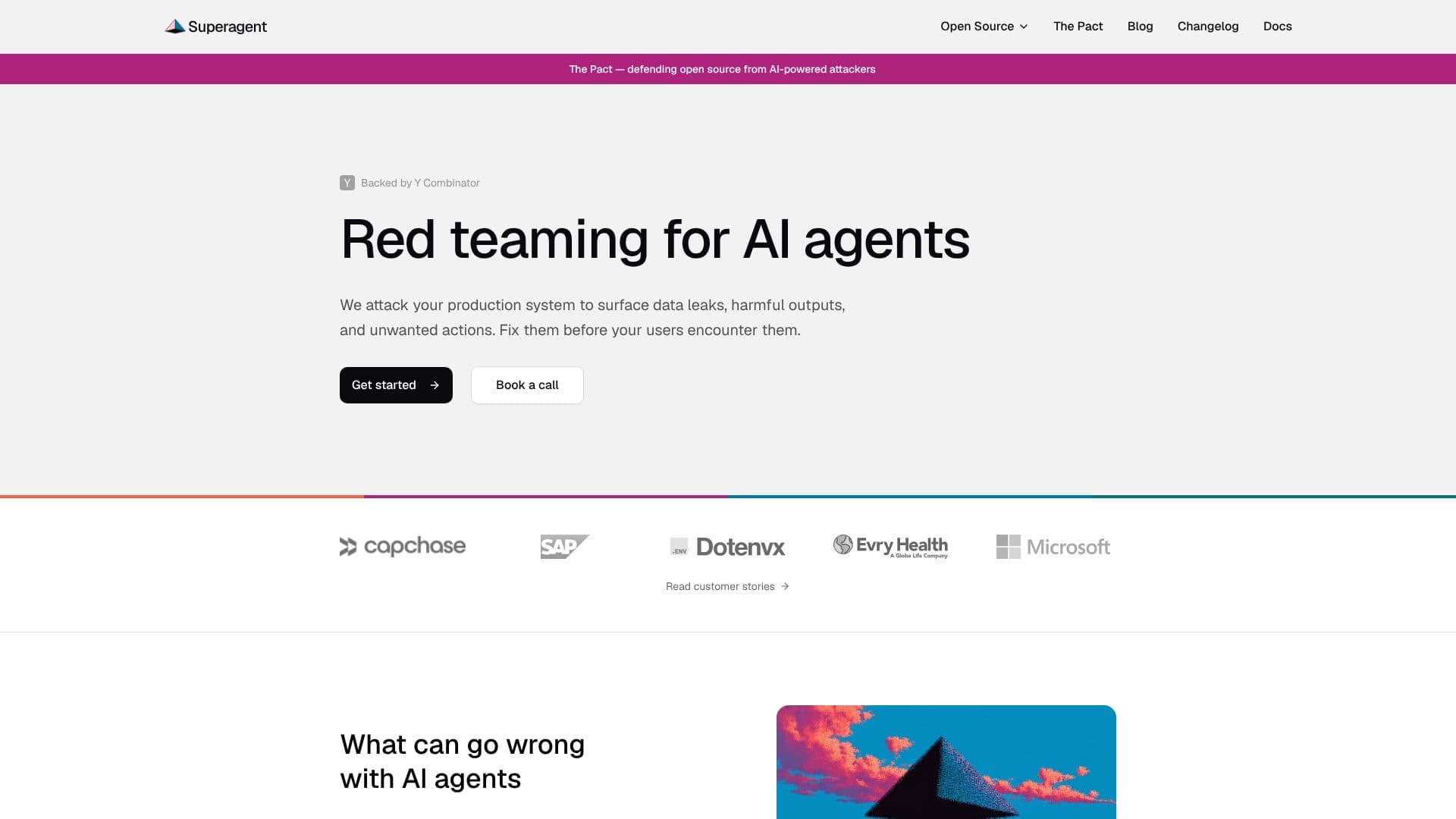
Superagent describes itself as an autonomous security factory: a set of specialized AI security workers that watch over applications, coding agents, infrastructure and repositories on an ongoing basis, rather than running a one-off scan.
Read More
Each worker owns one job end to end. A PR security worker screens incoming pull requests and contributors, stopping risky code before it merges. A secure dependency updates worker turns vulnerable packages into tested, merge-ready pull requests automatically. A red team worker deploys attack agents against a live system, chaining vulnerabilities together the way a real attacker would to find exploit paths, then produces a report with findings, evidence and remediation guidance. Agent guardrails cover two angles: context guardrails screen inbound content, such as email, for phishing, prompt injection and malicious attachments before an AI agent reads it, and runtime guardrails stop agents from leaking secrets or breaking policy while they run.
Superagent connects into workflows teams already use rather than adding a separate dashboard to check. It integrates with GitHub for repositories, and with coding agents and platforms including Cursor, Claude Code, Codex and Devin. Documented setups include scheduling recurring red team runs that send triaged findings into Cursor for review, and triggering Devin from a pull request webhook to test a dependency update before merge.
The company is backed by Y Combinator and says its tools are used on more than 3,000 open source projects. Public customer accounts describe it chaining vulnerabilities together to find and patch an exploit before an external threat scanner flagged the same issue, and using its guardrails to run AI agents with less risk day to day.
Open source repositories get unlimited use for free. Private repositories run on a credit system: every plan includes every product, API and MCP access, and unlimited seats. There's a free private tier with 100 credits a month, then paid plans starting at $499 a month for 500 credits, a recommended $1,499-a-month plan with 2,000 credits, and a $3,999-a-month plan and up for high-volume programs. Credit costs vary by product, from 1 credit per PR scan to 500 credits per red team report, and annual billing includes 20% more credits.
- CategoryAI Cybersecurity Tools
- Pricing ModelFreemium
- DeploymentCloud
- PlatformsWeb
Superagent's Core Features
PR security worker blocks risky code and untrusted contributors before a merge
Secure dependency updates that turn vulnerable packages into tested, merge-ready pull requests
Red team worker chains exploit paths against a live system like a real attacker
Context guardrails screen inbound content such as email for phishing and prompt injection
Runtime guardrails stop agents from leaking secrets or breaking policy while running
Scheduled, always-on red team runs that send triaged findings into tools like Cursor
Integrates with GitHub, Cursor, Claude Code, Codex and Devin
API and MCP access included on every plan
Free, unlimited use on public open source repositories
Credit-based pricing for private repositories, metered per product
How to use Superagent?
Connect your repository: Link a GitHub repository, public or private, to Superagent.
Turn on PR security: Screen incoming pull requests and contributors before they merge.
Schedule a red team run: Point Superagent's attack agents at your live system to find exploit paths.
Set up guardrails: Add context guardrails on inbound channels and runtime guardrails around your agents.
Review findings: Read triaged reports with evidence and remediation guidance, or route them into Cursor or Devin.
Track usage: Monitor credit usage by product across PR scans, red team reports and guardrail checks.
Superagent's Use Cases
- Automated PR security
- Scheduled red teaming
- Agent email guardrails
- Dependency patch automation