Description
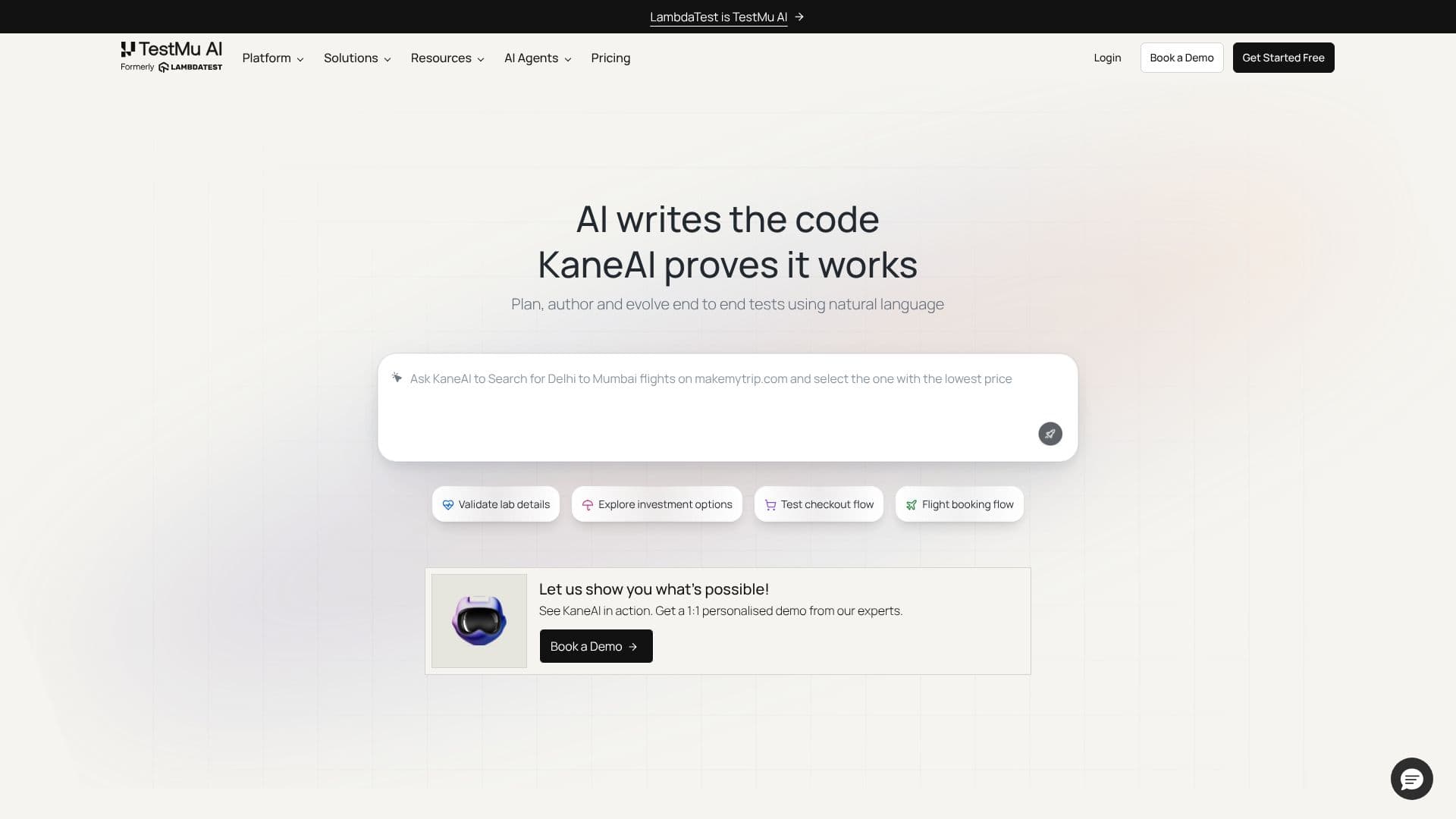
KaneAI by TestMu AI is a generative AI-powered testing agent designed to revolutionize software quality engineering. It functions as an autonomous agent that plans, authors, runs, and self-heals tests across web, mobile, UI, API, database, network, and accessibility layers within a single, connected flow. This approach aims to significantly boost productivity and ensure comprehensive test coverage.
Read More
One of KaneAI's core capabilities is its ability to generate test cases from various inputs like Jira tickets, PRDs, PDFs, screenshots, or spreadsheets, transforming them into structured, executable tests. The platform emphasizes no-code, codeless test automation, allowing users to author tests using natural language, eliminating the need for complex scripting. This democratizes test creation, making it accessible beyond traditional engineering roles.
KaneAI offers advanced features such as real-time network checks to identify broken APIs and slow endpoints, pixel-perfect validation for visual regression, and built-in accessibility audits adhering to WCAG standards. It also supports database-ready tests by connecting to databases and generating tests from live queries. For collaborative workflows, KaneAI can validate pull requests directly in GitHub by reading diffs and posting results back into the thread.
The agent is designed with a human-in-the-loop approach, allowing users to review test plans before execution, steer the agent in real-time, and triage failures step-by-step. Its intelligent and modular design ensures tests are robust and adaptable. Self-healing tests automatically update affected steps as UI elements change, and built-in versioning allows for easy rollback. KaneAI also supports adaptive flow control with natural language If/Else and While loops, and reusable modules for scalable test suites.
Integration with existing developer workflows is a key focus. KaneAI offers native integrations with Jira and Azure DevOps, allowing test case management directly within these platforms. It also provides a CLI for terminal-based automation and exports generated tests to popular frameworks like Selenium, Playwright, Cypress, and Appium, ensuring no vendor lock-in. The platform is enterprise-ready with features like SSO, RBAC, and audit logs.
KaneAI is part of the broader TestMu AI Quality Engineering Ecosystem, which includes HyperExecute for accelerated test execution on a vast device grid, Test Manager for test case storage, SmartUI for visual testing, and accessibility testing audits. This integrated approach aims to streamline the entire quality engineering lifecycle.
- CategoryAI Code Review & Testing
- Pricing ModelContact Us
- DeploymentCloud
- PlatformsWeb
KaneAI: AI Testing Agent's Core Features
Autonomous AI testing agent for end-to-end test automation
Natural language test authoring (no-code, codeless)
Generates test cases from Jira tickets, PRDs, PDFs, screenshots, and spreadsheets
Validates web, mobile, UI, API, database, network, and accessibility layers
Real-time network checks for API performance and failures
Pixel-perfect validation for visual regression testing
Built-in WCAG accessibility audits with severity prioritization
Self-healing tests that adapt to UI changes
Human-in-the-loop control for test execution and failure triage
Native integrations with Jira and Azure DevOps
Exports tests to Selenium, Playwright, Cypress, and Appium
Validates GitHub pull requests by posting results directly
Enterprise-ready with SSO, RBAC, and audit logs
How to use KaneAI: AI Testing Agent?
Configure: Connect your data sources and integrate with your existing tools like Jira or GitHub.
Author: Describe test scenarios and objectives in plain English.
Review: Approve the test plan drafted by KaneAI before execution.
Execute: Run tests autonomously across web, mobile, and API layers.
Evolve: Allow KaneAI to self-heal tests as your application changes.
Analyze: Review detailed AI-native insights on test failures and performance.
KaneAI: AI Testing Agent's Use Cases
- Autonomous Test Generation
- Codeless Test Authoring
- End-to-End Testing
- Visual Regression Testing
- API and Network Testing
- Accessibility Auditing
- CI/CD Integration
- Database Testing
- Cross-Platform Validation
- Enterprise Quality Assurance