
Description
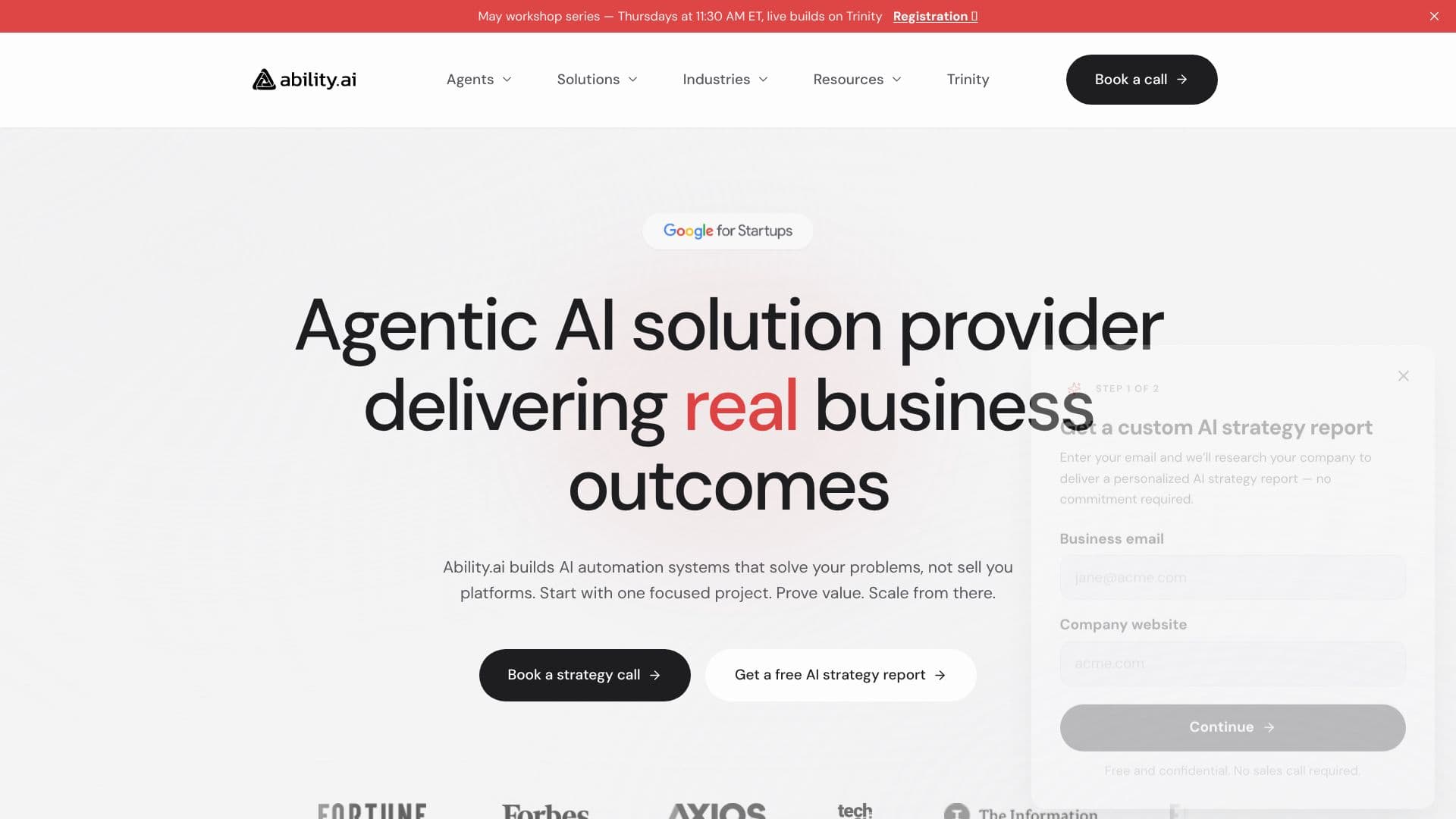
Ability.ai describes itself as an applied AI lab building the intelligence and infrastructure behind AI agents for businesses, rather than selling a single software product. Its work centers on two pieces: Trinity, an open-source production runtime, and Cornelius, a self-improving cognitive core that the agents run on and learn from.
Read More
Trinity is the runtime that agents live on: scheduled, audited, multi-user and recoverable, and designed to run inside a company's own infrastructure rather than as hosted SaaS. Cornelius is described as a living knowledge graph the agents share, meant to get sharper with each run and pass what it learns to the rest of the fleet. Both ship together as one open-source project under an Apache 2.0 license; an Enterprise tier adds governance features on top, including user and org management, SSO, RBAC, a compliance suite, data retention controls and license management for offline or air-gapped use.
Ability.ai lists agents already running in production for outbound sales and lead enrichment, customer support triage, content drafting and scheduling, recruiting operations (job-description parsing, Boolean search, candidate tracking), market research briefings, and back-office work such as email, scheduling and CRM hygiene. It targets business functions including marketing, sales, recruiting, operations, finance, IT and software development, and lists industries such as B2B SaaS, e-commerce, professional services and marketing agencies.
The company offers three ways to work with it: a managed track where Ability.ai designs, builds and runs the agents in a client's operations; an open-source track where a company self-hosts Trinity and Cornelius and builds its own agents; and a partner track where agencies resell the technology under their own name with Ability.ai providing the technology and support behind it.
Ability.ai emphasizes governance alongside automation: agents follow business rules approved before deployment, log every action with what it calls full chain-of-thought transparency, and escalate decisions that need a person's sign-off. The company states it has documented 70-95% time savings on the work its agents automate across its production deployments, and cites one client's first-response time dropping from a business day to seven minutes.
- CategoryAI Agent Builders
- Pricing ModelSolutions-based
- DeploymentSelf-hosted, Cloud
- PlatformsWeb
Ability.ai's Core Features
Trinity: open-source, self-hostable production runtime for AI agents
Cornelius: shared, self-improving cognitive core / knowledge graph
Scheduling, auditing and recovery built into the runtime
Enterprise governance add-ons: SSO, RBAC, compliance suite, data retention controls
Prebuilt agents for outbound sales, support triage, recruiting ops, market research and back-office work
Chain-of-thought action logging for review and override
Human approval gates before agents act on business rules
Managed, open-source and partner delivery tracks
How to use Ability.ai?
Choose a track: Decide between self-hosting, having Ability.ai run agents for you, or partnering to resell.
Pick a process: Start with one focused workflow, such as support triage or outbound sales.
Deploy Trinity: Self-host the open-source runtime, or have Ability.ai deploy it inside your infrastructure.
Connect Cornelius: Let the cognitive core start learning from your business data and agent runs.
Set guardrails: Approve the business rules and escalation points agents must follow.
Review and scale: Check chain-of-thought logs, then extend agents to more processes.
Ability.ai's Use Cases
- Outbound sales & enrichment
- Customer support triage
- Recruiting operations
- Back-office automation