
Description
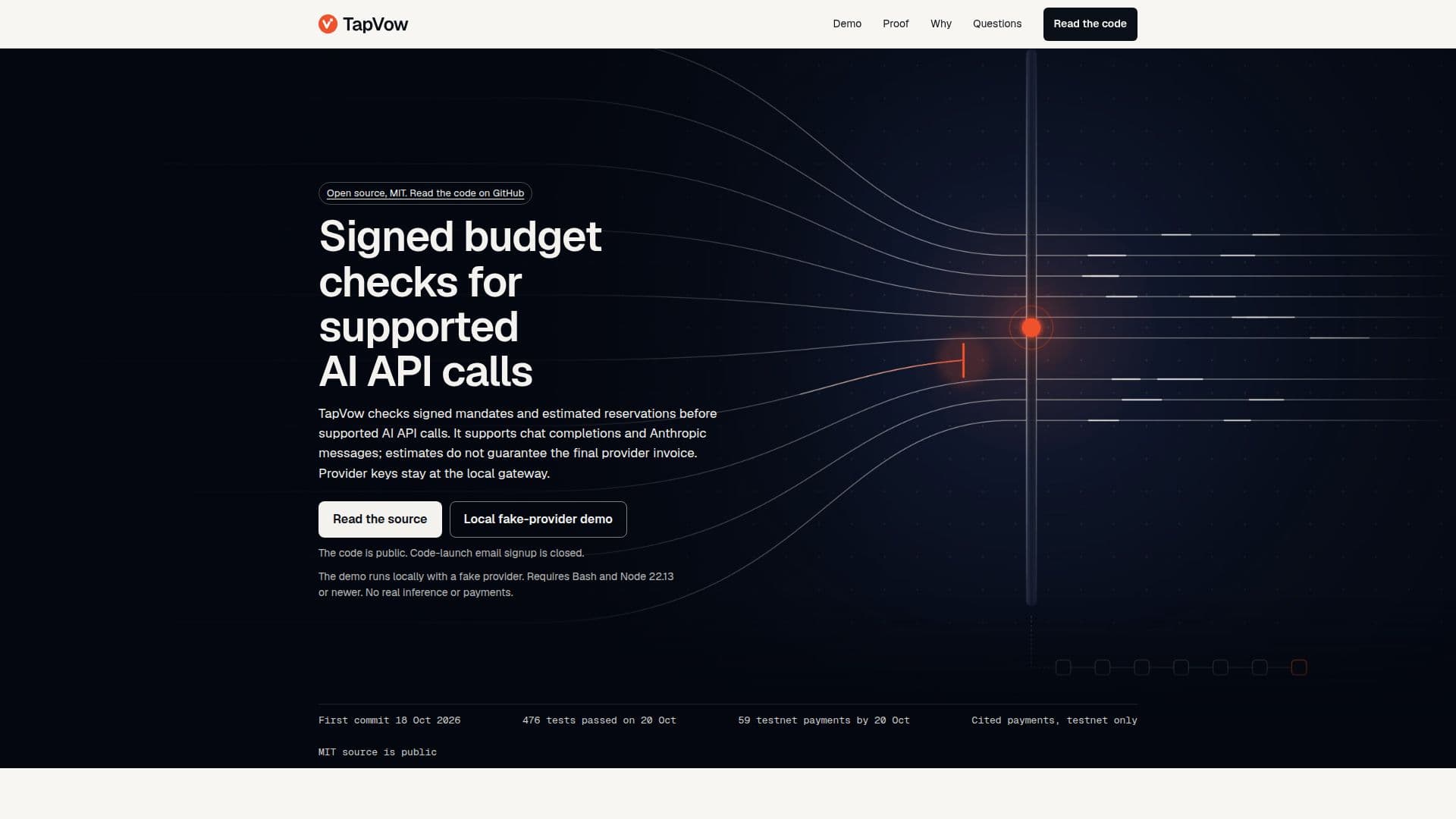
TapVow functions as a local gateway that provides signed budget checks for supported AI API calls. Its primary purpose is to help users manage and control their spending on AI services by verifying signed mandates and estimated reservations before any API call is made. This ensures that calls adhere to predefined budgets and permissions, preventing unexpected costs.
Read More
The system operates by keeping provider keys within the local gateway, enhancing security and control over API access. It supports specific AI API formats, including OpenAI chat completions and Anthropic messages, such as Claude Code with API-key billing and OpenCode. However, it does not support Responses API/Codex or Claude Pro/Max subscription traffic.
TapVow generates verifiable signed receipt packs, which are crucial for integrity verification and auditing. The platform allows for the configuration of signed mandates that include budgets, per-call limits, allowed payees, and expiry dates. Supported clients can use virtual keys to point at the gateway, which then performs admission checks based on estimated reservations. If a call exceeds the set limits, the gateway can return an HTTP 402 error, blocking the request.
The tool also offers a `tapvow verify` function, which uses pinned keys to check receipt-pack signatures, chain, head, and totals, ensuring the authenticity and integrity of transactions. While estimated reservations are a core feature, it's important to note that they do not guarantee the final provider invoice. The project is open-source under an MIT license, with its code publicly available on GitHub. The prototype is a local gateway, and the operator is responsible for supplying provider credentials and any wallet funding. Testnet payments have been demonstrated, but these do not establish production payment use or a custody service.
- CategoryAI DevOps & Cloud Tools
- Pricing ModelOpen Source
- DeploymentLocal Gateway
- PlatformsWeb
TapVow's Core Features
Local Gateway for AI API Calls
Signed Budget Mandate Checks
Estimated Reservation Verification
Virtual Keys for Supported Clients
Verifiable Signed Receipt Packs
Provider Keys Stay Local
Support for OpenAI Chat Completions
Support for Anthropic Messages (Claude Code, OpenCode)
Blocks Prompt-Injected Payments
Integrity Verification of Ledger Entries
Open-Source (MIT License)
Local Demo with Fake Provider
Configurable Per-Call Limits
Denial Logging for Over-Limit Calls
Passkey-Signed Budget Edits
How to use TapVow?
Configure Mandate: Set up a signed mandate with budgets, per-call limits, allowed payees, and expiry.
Point Client to Gateway: Configure supported AI API clients (e.g., Claude Code, OpenCode) to use TapVow's virtual keys.
Initiate API Call: Make an AI API call through the TapVow gateway.
Gateway Checks: TapVow checks estimated reservations and signed mandates before admitting the call.
Receive Verification: Obtain verifiable signed receipt packs for integrity verification.
Verify Receipts: Use `tapvow verify` with pinned keys to check receipt-pack signatures and totals.
TapVow's Use Cases
- AI API Cost Control
- Secure AI API Access
- Verifiable AI Usage Auditing
- Preventing Prompt Injections
- Multi-Agent Budget Management
- Developer Testing of AI Integrations