
Description
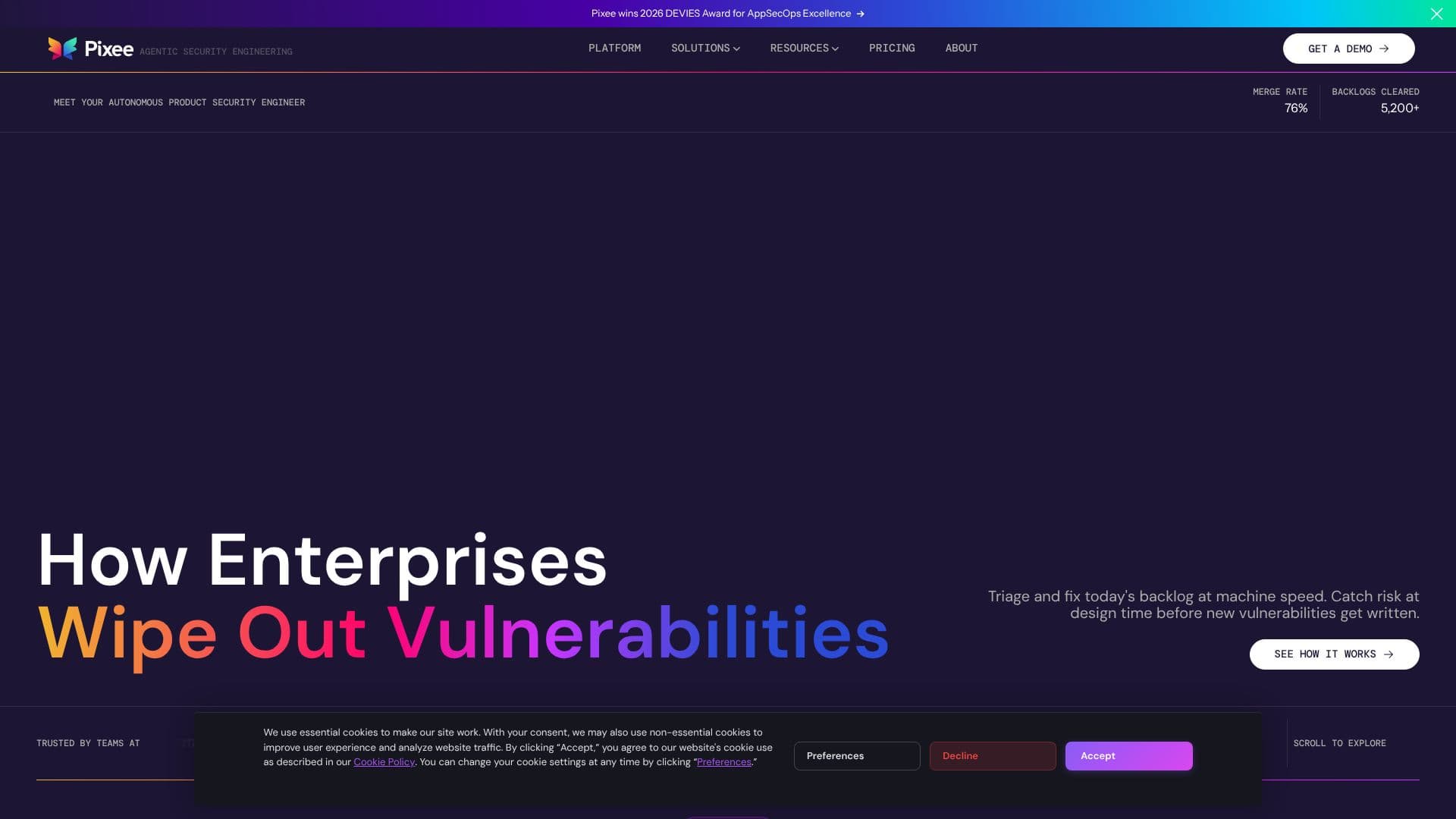
Pixee offers an agentic approach to application security, designed to address the widening gap between rapid AI-accelerated development and manual security processes. The platform tackles the challenge of overwhelming vulnerability backlogs and the shrinking time between vulnerability discovery and exploitation.
Read More
Pixee's solution focuses on both reactive remediation and proactive design review. It aims to resolve existing vulnerabilities at machine speed while preventing new ones from being introduced. By acting as an autonomous product security engineer, Pixee analyzes codebases, security policies, and architecture to understand the real attack surface. It then identifies genuinely exploitable vulnerabilities by tracing execution paths, eliminating up to 98% of false positives and providing evidence-based triage with personalized risk scores.
Once real risks are identified, Pixee generates convention-aware fixes that match organizational coding standards and security rules. These fixes are delivered as ready-to-merge pull requests, ensuring high developer adoption rates, with a reported 76% merge rate. The platform's unique context graph builds a "security memory" for the organization, where every decision, triage, and fix feeds back into the system, sharpening future reviews and remediation. This compounding context graph includes process context (policies, architecture), raw context (code, findings), kinetic context (exploitability), and human feedback.
Pixee is built for modern security teams looking to keep pace with AI-driven development, scale security efforts without proportional hiring, ship on time by clearing release blockers, and eliminate years of vulnerability debt. The platform's value proposition centers on stopping the management of vulnerabilities and starting their elimination through automated, context-aware remediation and design-time risk detection.
Key capabilities include understanding the attack surface, identifying exploitable risks, generating developer-accepted fixes, and building a compounding context graph. Pixee aims to transform security from a manual bottleneck into an integrated, efficient part of the software development lifecycle, enabling teams to achieve a higher security posture with greater speed and efficiency.
- CategoryAI Code Review & Testing
- Pricing ModelContact sales
- DeploymentCloud
- PlatformsWeb
Pixee's Core Features
Automated vulnerability triage and remediation
Eliminates up to 98% of false positives
Generates convention-aware, ready-to-merge fixes
76% developer merge rate for fixes
Proactive risk detection at design time
Builds a compounding organizational security context graph
Analyzes codebase, security policies, and architecture
Traces real execution paths for exploitability analysis
Personalized risk scoring for vulnerabilities
Integrates security into the development lifecycle
Reduces vulnerability backlogs at machine speed
Provides auditable and replayable decisions
How to use Pixee?
Configure: Connect Pixee to your codebase, security policies, and architecture.
Analyze: Pixee understands your attack surface and identifies exploitable vulnerabilities.
Triage: Eliminate false positives and prioritize real risks.
Remediate: Generate convention-aware fixes and create pull requests.
Merge: Developers review and merge fixes, clearing backlogs.
Optimize: The context graph learns from every decision to improve future security.
Pixee's Use Cases
- Automated Vulnerability Remediation
- False Positive Reduction
- Proactive Security Design
- Vulnerability Backlog Clearance
- Enhance Developer Productivity
- AI Security Guardrails
- Scale Security Operations