


Description
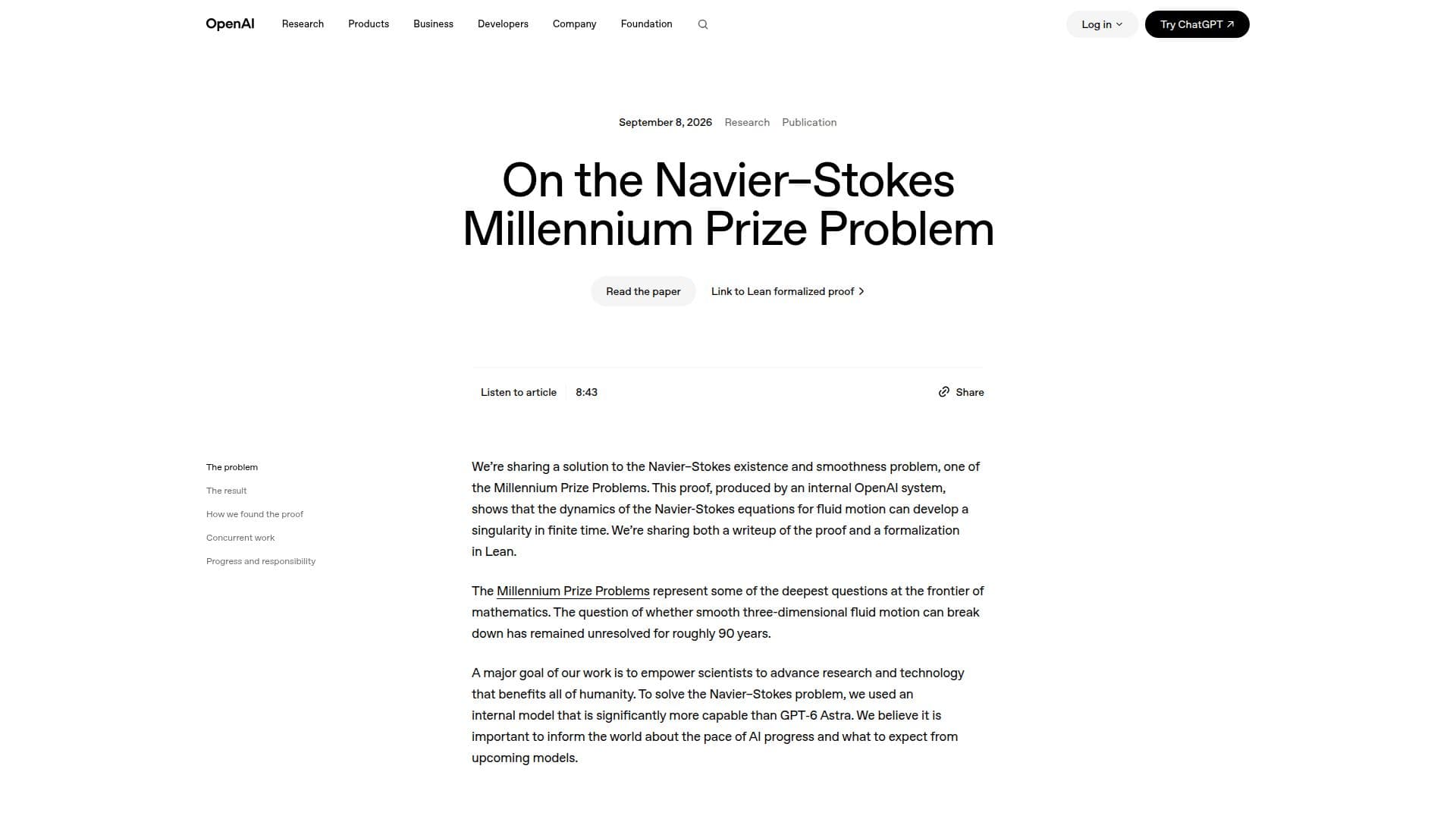
OpenAI has developed an AI-generated solution to the Navier-Stokes Millennium Prize Problem, a significant challenge in mathematics concerning the behavior of fluid motion equations. The solution includes both a detailed writeup and a formal proof in Lean, demonstrating that the dynamics of the Navier-Stokes equations can develop a singularity in finite time. This finding addresses the long-standing question of whether smooth three-dimensional fluid motion can break down, a problem unresolved for nearly 90 years.
The Navier-Stokes equations, which date back to the work of Claude-Louis Navier and George Gabriel Stokes in the nineteenth century, describe how fluids move using Newton’s second law of motion. These equations are crucial for applications such as aircraft design, weather forecasting, and studying blood flow. A central question has been whether the continuum approximation of fluid can break down, leading to a singularity where fluid speeds grow without bound within a finite time.
OpenAI's internal system, more capable than GPT-6 Astra, produced an analytical proof and a Lean formalization showing that an initially smooth fluid at rest can develop a singularity in finite time. The proof involves a vortex, a spinning swirl of fluid that spirals inward and elongates, maintaining finite energy throughout the dynamics. This achievement resolves the Navier-Stokes Millennium Prize problem by establishing specific statements in the official formulation.
The solution was achieved using a system of coordinating agents powered by OpenAI's internal model. These agents, numbering around 10,000, communicated and collaborated to explore various approaches to the problem. The process involved cross-pollinating insights from different agent groups and utilizing Codex to consolidate useful findings. The agents arrived at their resolution within 88 hours, with Lean formalization and verification taking an additional 17 hours.
OpenAI's goal in releasing this result is to highlight the substantial progress of AI models. While they do not intend to claim the Millennium Prize, this milestone represents significant work by mathematicians and AI researchers. OpenAI continues to focus on understanding and advancing AI capabilities to ensure that artificial general intelligence benefits all of humanity.
OpenAI Navier-Stokes Solution's Core Features
AI-generated solution to Navier-Stokes problem
Formal proof in Lean
Addresses fluid motion equations
Demonstrates singularity development
Involves coordinating agents
Utilizes internal model more capable than GPT-6 Astra
Cross-pollination of agent insights
Lean formalization and verification
How to use OpenAI Navier-Stokes Solution?
Understand: Read the AI-generated writeup
Analyze: Review the formal proof in Lean
Explore: Study the dynamics of fluid motion
Apply: Consider implications for fluid dynamics research
OpenAI Navier-Stokes Solution's Use Cases
- Fluid Dynamics Research
- Mathematical Proof Verification
- AI Model Evaluation
- Engineering Applications
- Scientific Collaboration


