


Description
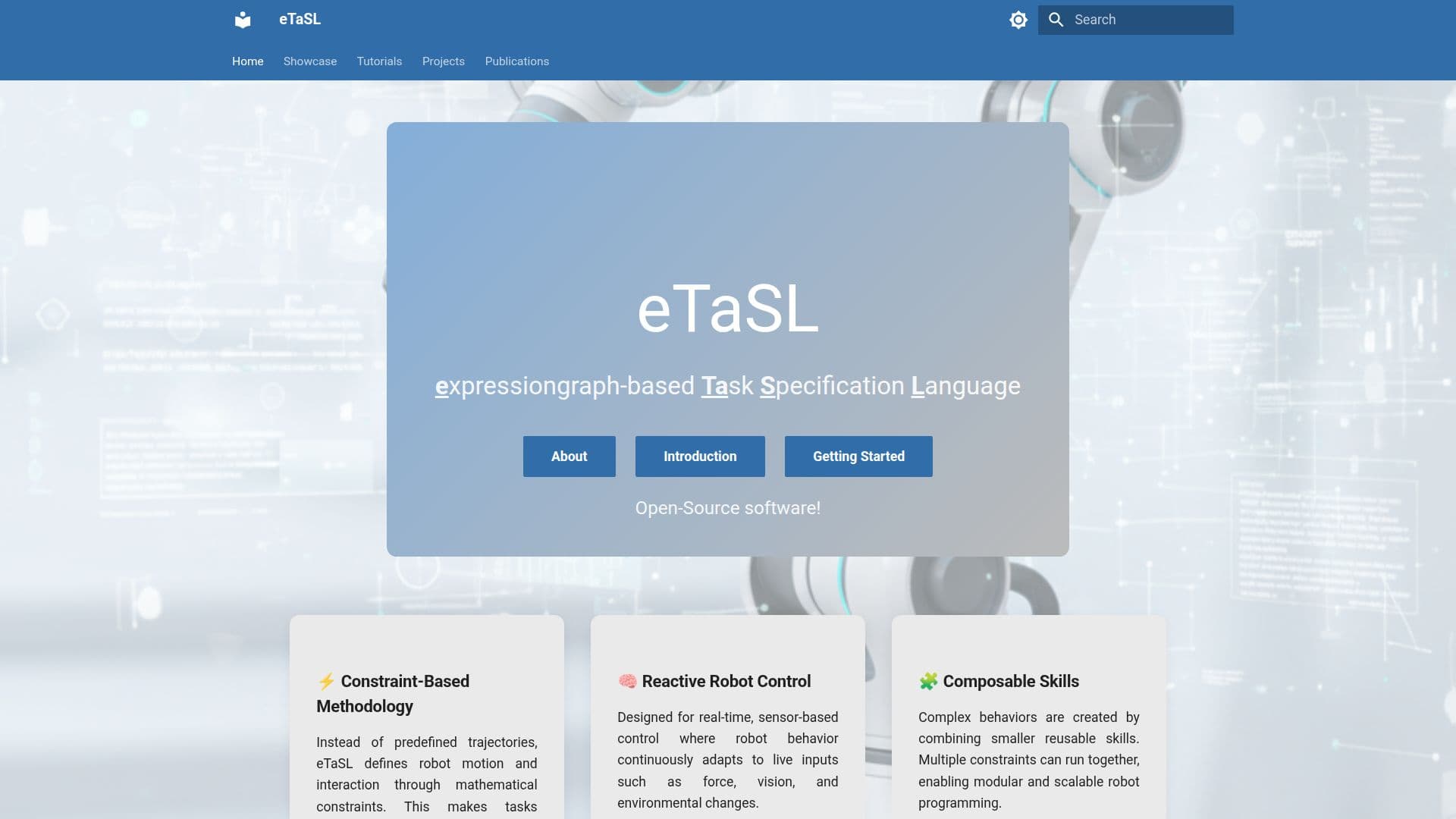
eTaSL, or expressiongraph-based Task Specification Language, is an open-source software framework designed for robotic task specification. It was officially introduced in 2014 by the Robotics Research Group at KU Leuven. The framework employs a constraint-based methodology, allowing for the definition of robot motion and interaction through mathematical constraints rather than predefined trajectories. This approach makes tasks more flexible, adaptive, and easier to modify, especially for complex robotic applications.
One of the key features of eTaSL is its reactive robot control capability. It is designed for real-time, sensor-based control, where robot behavior continuously adapts to live inputs such as force, vision, and environmental changes. This makes it suitable for applications requiring high adaptability and precision.
eTaSL also supports composable skills, enabling the creation of complex behaviors by combining smaller, reusable skills. Multiple constraints can run simultaneously, allowing for modular and scalable robot programming. The framework includes an optimization-based solver that converts all constraints into a quadratic programming problem, solving it continuously for smooth and stable motion, even when multiple objectives conflict.
The framework offers strong sensor integration, supporting force/torque sensors, vision systems, tactile sensors, and artificial skin for advanced closed-loop robotic interaction and perception. It also supports multi-robot systems, including dual-arm robots and complex robotic systems, enabling coordination between multiple manipulators, sensors, and distributed robotic components.
eTaSL has evolved over the years, with a major upgrade in 2026 leading to the development of cROSpi, which builds upon the core concepts of eTaSL while introducing significant architectural improvements. cROSpi extends the original concepts with a more unified architecture and improved usability, and is currently the actively developed version of the framework.
eTaSL ROS2 Framework's Core Features
Open-source software
Constraint-based methodology
Reactive robot control
Composable skills
Optimization-based solver
Strong sensor integration
Multi-robot support
Virtual joint feature variables
How to use eTaSL ROS2 Framework?
Explore: showcase videos for practical insights
Understand: eTaSL task specifications
Develop: use cROSpi for new developments
Integrate: sensors and multi-robot systems
eTaSL ROS2 Framework's Use Cases
- Real-time control
- Multi-robot coordination
- Complex task specification
- Sensor integration
- Composable skills