
Description
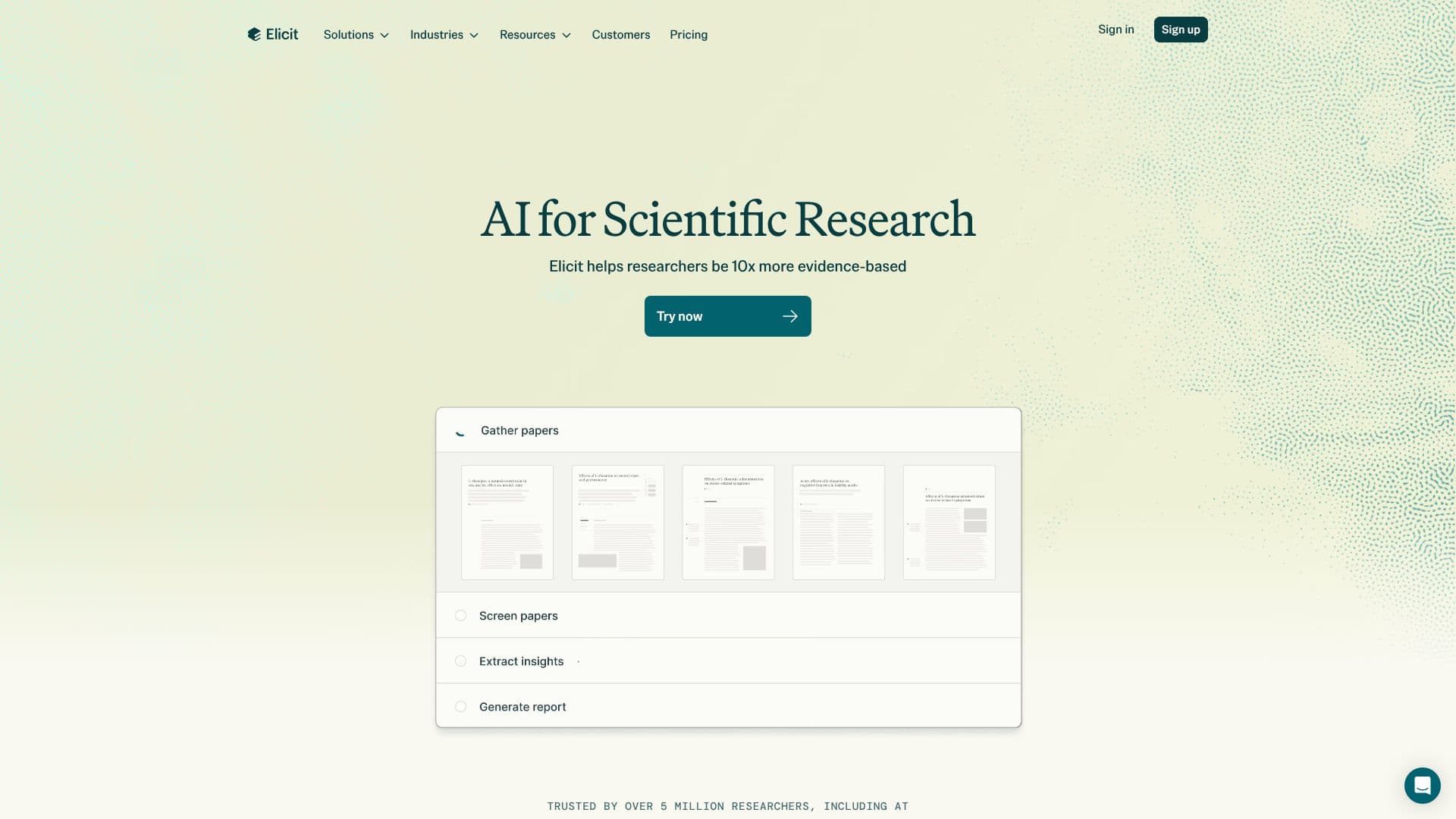
Elicit is an AI tool designed to accelerate scientific research by automating key aspects of the research process. It empowers researchers to understand existing knowledge more quickly, allowing them to focus on discovering the unknown. The platform searches through a vast database of over 138 million academic papers and 545,000 clinical trials, with more data sources continuously being added.
Read More
Elicit's semantic search capabilities mean users don't need to know precise keywords to find relevant information. A core feature is its ability to generate high-quality research briefs, inspired by systematic review methodologies. These reports are deeply customizable, allowing users to control the papers and information included, differentiating Elicit from other AI tools. For systematic literature reviews, Elicit offers significant automation, with researchers reporting up to 80% time savings in screening and data extraction. The platform also partially supports search and report generation for these reviews.
Beyond immediate research needs, Elicit includes a library feature to store and organize sources for future projects. Elicit Alerts help researchers stay updated on new publications without overwhelming their inboxes. What sets Elicit apart is its scale, capable of finding up to 1,000 relevant papers and analyzing up to 20,000 data points at once. Its accuracy is highlighted, with all AI-generated claims supported by sentence-level citations from the source material, ensuring transparency. Elicit goes beyond simple chat interfaces, offering interactive tables and multi-step workflows.
The tool serves a wide array of industries, including pharmaceuticals for drug development, academia for scientific advancement, medical devices and technology for product design, policy and government for evidence-based decision-making, consumer goods for product improvement, and industrials for material discovery. Researchers in software and technology can leverage Elicit for innovation in user experience and algorithmic performance. Elicit's recent updates include support for PRISMA 2020 guidelines in its systematic review tool, an API for programmatic access, and enhanced screening options.
- CategoryAI Research Assistants
- DeploymentCloud
- PlatformsWeb
Elicit's Core Features
Search over 138 million academic papers and 545,000 clinical trials
Semantic search for relevant results without exact keywords
Automated generation of structured research reports with citations
Customizable research briefs
Automation for systematic literature review screening and data extraction
Up to 80% time savings reported for systematic reviews
Library for organizing and reusing research sources
Elicit Alerts for staying updated on new research
Scalable analysis of up to 1,000 papers and 20,000 data points
Sentence-level citations for AI-generated claims
Interactive tables and multi-step workflows
Support for PRISMA 2020 guidelines in systematic reviews
Elicit API available for programmatic access
How to use Elicit?
Define Research Question: Input your research question into Elicit.
Search & Discover: Elicit searches millions of papers using semantic understanding.
Generate Report: Automatically create a structured research report with citations.
Customize & Refine: Adjust report content and papers included.
Conduct Systematic Reviews: Automate screening and data extraction.
Organize Sources: Save and manage relevant papers in your library.
Stay Updated: Set up alerts for new research in your field.
Elicit's Use Cases
- Literature Review Automation
- Research Report Generation
- Information Discovery
- Data Extraction
- Staying Updated
- Evidence-Based Policy
- Drug Development