


Description
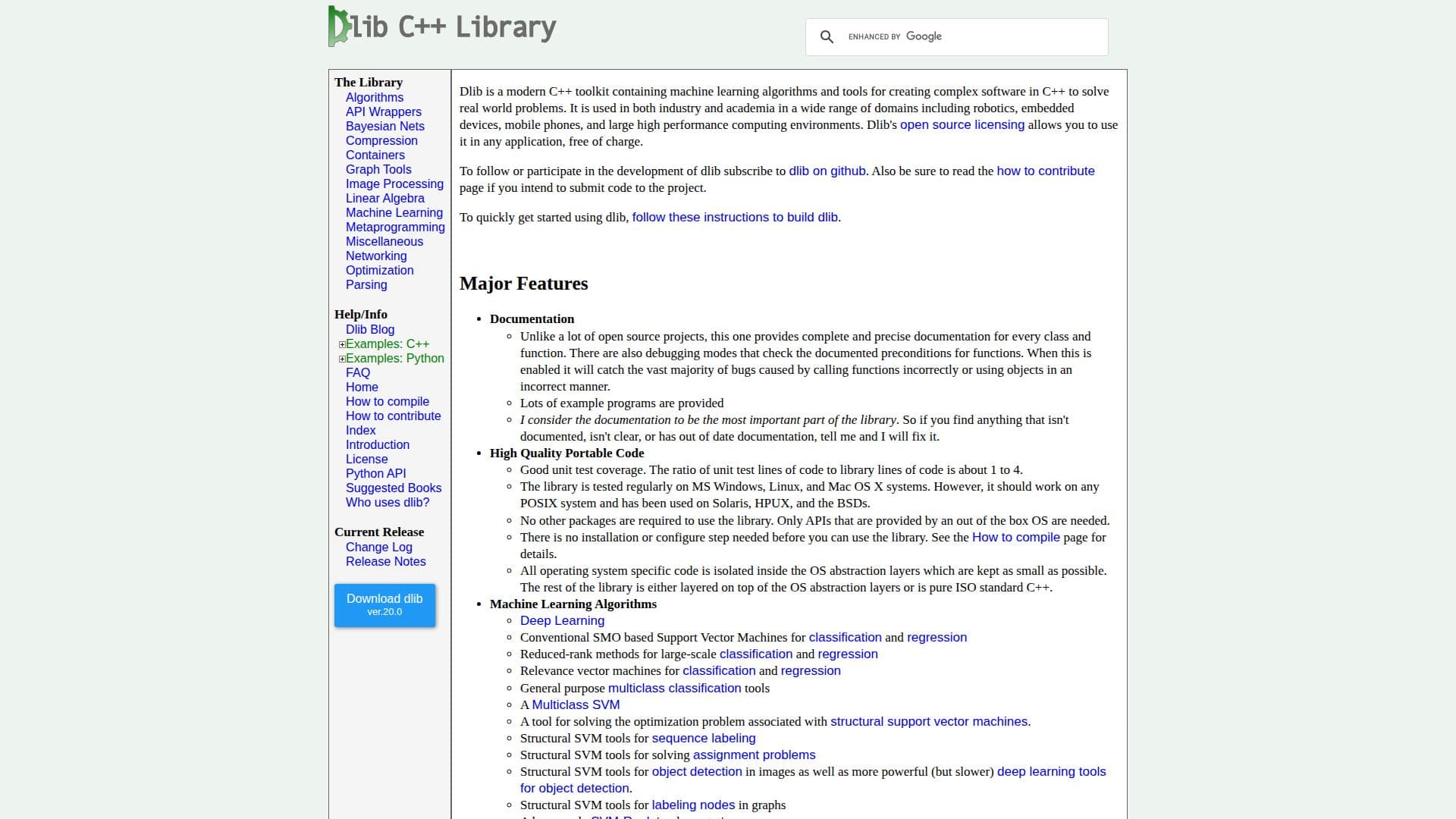
Dlib is a comprehensive C++ library that provides a wide range of machine learning algorithms and tools for creating complex software solutions. It is extensively used in both industry and academia across various domains such as robotics, embedded devices, mobile phones, and high-performance computing environments. The library is open source, allowing users to integrate it into any application without charge.
One of the standout features of Dlib is its complete and precise documentation, which covers every class and function. This ensures that developers can easily understand and utilize the library's capabilities. Additionally, Dlib includes debugging modes that check the documented preconditions for functions, helping to catch bugs caused by incorrect usage.
Dlib offers high-quality, portable code with good unit test coverage. It is regularly tested on MS Windows, Linux, and Mac OS X systems, and can work on any POSIX system. The library does not require any additional packages, relying only on APIs provided by the operating system.
The library includes a variety of machine learning algorithms, such as deep learning, support vector machines, and clustering algorithms. It also provides numerical algorithms for linear algebra and optimization, graphical model inference algorithms, and image processing routines. Dlib supports threading and networking, offering a simple API for TCP sockets and HTTP servers.
Dlib's graphical user interface tools are portable and thread-safe, and it includes data compression and integrity algorithms. The library also provides a modular unit testing framework and various general utilities, making it a versatile tool for developers.
Dlib C++ Library's Core Features
Complete and precise documentation
High-quality portable code
Machine learning algorithms
Numerical algorithms
Graphical model inference
Image processing routines
Threading and networking support
Graphical user interface tools
Data compression and integrity algorithms
Modular unit testing framework
General utilities
How to use Dlib C++ Library?
Download: Obtain the Dlib library from the official website or GitHub.
Compile: Follow the instructions to build Dlib on your system.
Integrate: Use Dlib's APIs in your C++ projects.
Develop: Create applications using Dlib's machine learning and image processing tools.
Contribute: Participate in the development of Dlib on GitHub.
Dlib C++ Library's Use Cases
- Robotics
- Embedded Devices
- Mobile Applications
- High-Performance Computing
- Image Processing