
Description
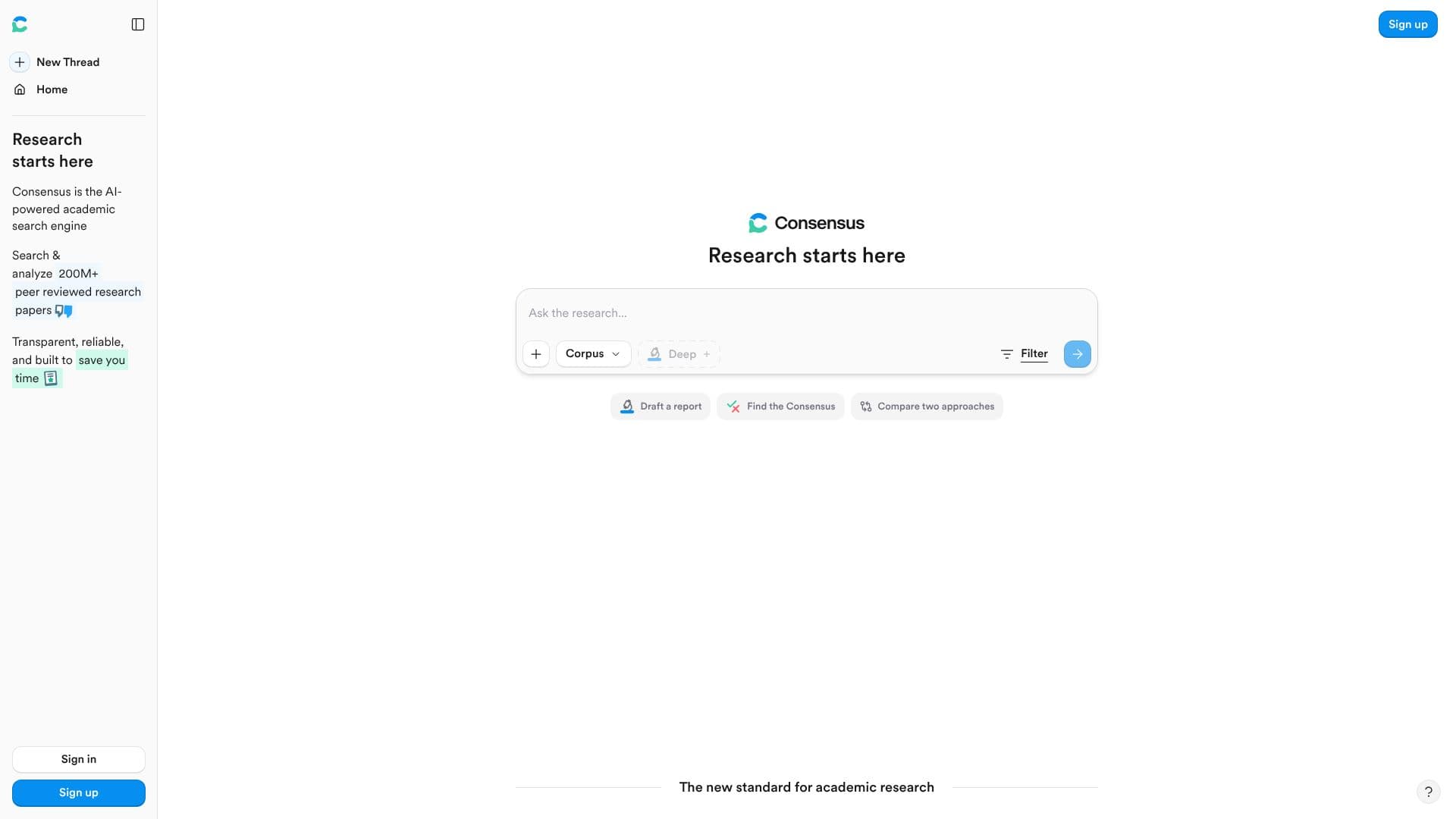
Consensus serves as the new standard for academic research, empowering users to search and analyze peer-reviewed literature with unprecedented speed and efficiency. Leveraging a vast corpus of over 250 million research papers, including licensed full-text content from leading publishers, Consensus provides a comprehensive foundation for scholarly inquiry. Its platform is trusted and utilized daily at over 170 university libraries, granting access to millions of researchers, students, and clinicians worldwide.
Read More
At its core, Consensus automates the literature review process through its Deep Search functionality. This advanced feature constructs a comprehensive search strategy by expanding key terms, identifying conflicting arguments, and exploring the citation graph, effectively condensing days of manual review into mere minutes. Users can explore historical consensus shifts on topics like hormone replacement therapy, summarize points of agreement and disagreement on complex subjects such as long COVID mechanisms, or compare different research designs like randomized versus observational evidence.
The platform offers a specialized Medical mode, narrowing results to high-quality medical sources. This includes approximately 50,000 clinical guidelines and 8 million articles from the top 1,000 medical journals, providing quick and trusted answers for clinical decision-making. Examples of medical queries include contraindications to tPA in acute ischemic stroke, duration of dual antiplatelet therapy, and comparisons of SGLT2 inhibitors versus GLP-1 agonists for renal outcomes.
Consensus also enables users to apply filters using natural language. Users can specify timeframes, populations, study designs, and other parameters directly within their prompts, and Consensus automatically applies the appropriate filters. This intuitive approach streamlines the process of finding relevant evidence, such as research on microplastic exposure and health excluding animal studies, or changes in gut microbiome diversity over the last decade.
Furthermore, the Consensus Meter provides a rapid, visual assessment of the research landscape. By posing a clear yes-or-no research question, users can instantly see the degree to which the existing evidence agrees or disagrees, offering a fast read on the state of scientific consensus. This feature is invaluable for quickly gauging the strength of evidence on topics like early intubation in ARDS, vitamin D supplementation efficacy, or the impact of SGLT2 inhibitors on mortality in type 2 diabetes.
- CategoryAI Research Assistants
- Pricing ModelContact sales
- DeploymentCloud
- PlatformsWeb
Consensus's Core Features
AI-powered academic search engine
Analyzes peer-reviewed literature
Automates literature reviews
Deep Search functionality for comprehensive strategy building
Identifies conflicting arguments and citation graphs
Medical mode for high-quality clinical sources
Natural language filtering for specific search parameters
Consensus Meter for visual evidence agreement assessment
Access to over 250 million research papers
Partnerships with over 170 university libraries
Used by millions of researchers, students, and clinicians
How to use Consensus?
Search: Enter your research question or keywords into the search bar.
Filter: Refine your search using natural language prompts or specialized filters like Medical mode.
Analyze: Utilize the Consensus Meter for a quick overview of evidence agreement.
Organize: Discover, organize, and analyze relevant research papers efficiently.
Draft: Use insights to draft reports and further your research.
Consensus's Use Cases
- Literature Review Automation
- Academic Research
- Clinical Decision Support
- Evidence Synthesis
- Research Strategy Development
- Student Research Projects