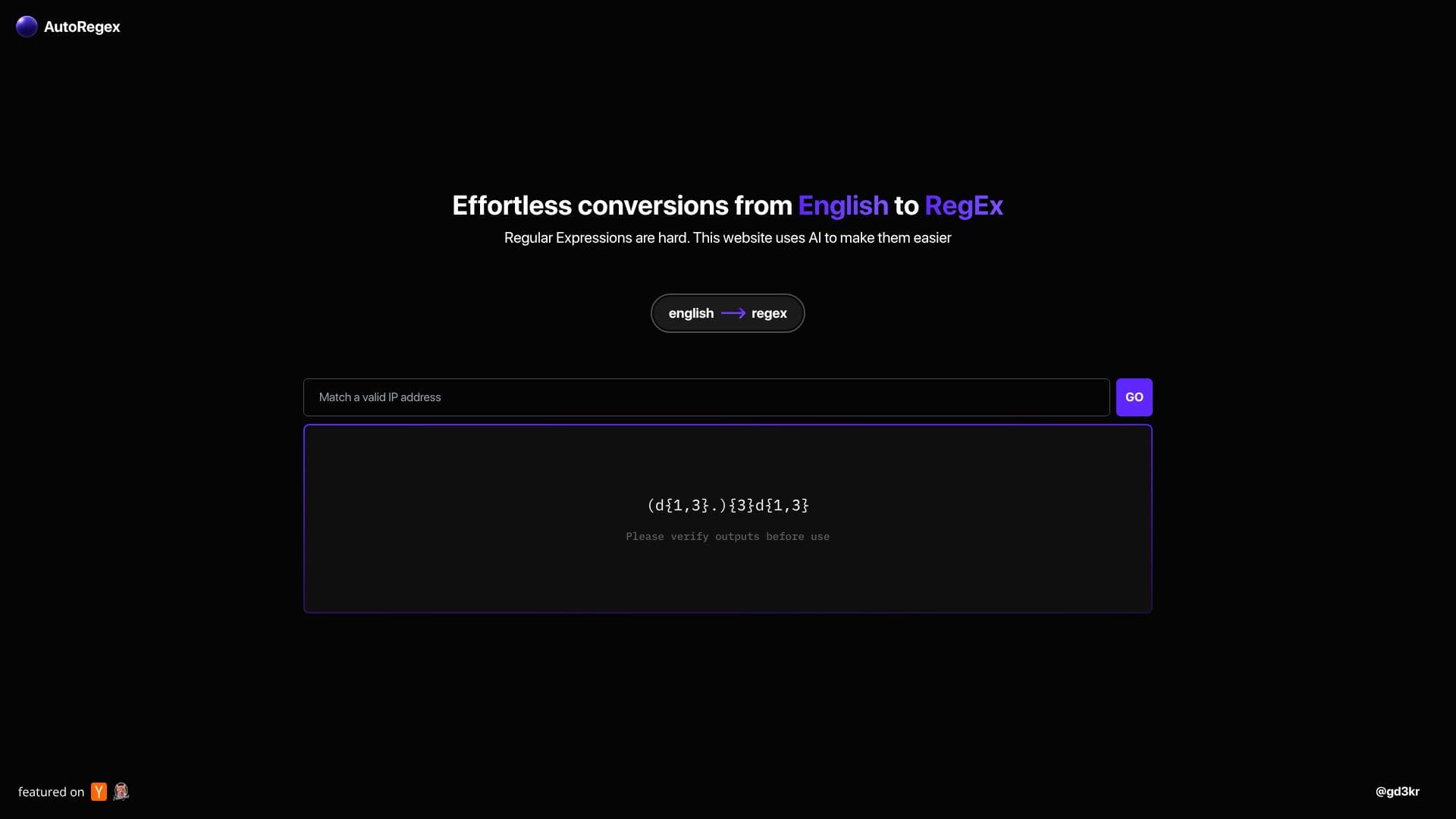
Description
Regular expressions, often referred to as RegEx, are powerful tools for pattern matching in text. However, their syntax can be notoriously difficult to learn and implement, posing a significant barrier for many developers, data analysts, and IT professionals. AutoRegex addresses this challenge by employing advanced Artificial Intelligence and Natural Language Processing (NLP) to bridge the gap between human language and machine-readable patterns.
Read More
The core functionality of AutoRegex lies in its ability to interpret natural language queries and translate them into functional regular expression code. Users can simply describe the pattern they are looking for in plain English, such as "match an email address" or "find all phone numbers in a specific format," and the AI engine will generate the corresponding RegEx. This dramatically reduces the time and effort required to create complex patterns, democratizing the use of RegEx.
AutoRegex is designed for a wide range of users who frequently work with text data and require efficient pattern matching. This includes software developers who need to validate input formats or parse log files, data scientists performing text analysis and data cleaning, cybersecurity professionals analyzing network traffic, and system administrators automating tasks. The tool's intuitive interface makes it accessible even to those with limited prior experience in regular expressions.
The primary benefit of AutoRegex is its ability to significantly lower the learning curve associated with regular expressions. By abstracting away the intricate syntax, it allows users to focus on defining their pattern requirements rather than wrestling with complex character sets and metacharacters. This leads to faster development cycles, fewer errors in pattern matching, and increased productivity. The AI's continuous learning capabilities also suggest potential for improving accuracy and handling increasingly nuanced requests over time.
While the tool aims to simplify RegEx creation, it is crucial for users to verify the generated outputs. The complexity of language and the nuances of pattern matching mean that AI-generated RegEx might require minor adjustments to perfectly fit specific edge cases or requirements. AutoRegex provides a powerful starting point, enabling users to achieve their pattern-matching goals more efficiently than ever before.
- CategoryAI Coding Assistants
- Pricing ModelFreemium
- DeploymentCloud
- PlatformsWeb
AutoRegex's Core Features
Converts English descriptions to RegEx using AI
Leverages Natural Language Processing (NLP) for interpretation
Simplifies complex RegEx syntax
Reduces the learning curve for regular expressions
Aids in pattern matching for text data
Generates functional RegEx code from plain language
Streamlines the process of creating RegEx patterns
Assists developers, data scientists, and IT professionals
Provides a starting point for RegEx generation
Aims to improve accuracy in pattern matching
How to use AutoRegex?
Describe Pattern: Clearly articulate the text pattern you need to match in plain English.
Input Description: Enter your English description into the AutoRegex interface.
Generate RegEx: The AI processes your input and generates a corresponding regular expression.
Verify Output: Review the generated RegEx to ensure it accurately matches your requirements.
Refine (if necessary): Make any minor adjustments to the RegEx for specific edge cases.
Implement: Use the verified RegEx in your application or workflow.
AutoRegex's Use Cases
- Email Validation
- Phone Number Matching
- Log File Parsing
- Data Cleaning
- URL Pattern Matching
- Text Analysis
- Input Field Validation